
CURRENT PUPAE - Chrysalides and cocoons
If you are a beginner and need information on rearing from small caterpillars, or hatching out pupae, please order the All Colour Paperback BUTTERFLIES. INSTRUCTIONS ARE NOT SENT WITH EACH SPECIES, you need to acquire basic skills and this book is a simple way of doing so.
Please Select a Category Below:

African Moon Moth Argema mimosae
The moth is a miniature of the Giant Madagascan Moon Moth as a whole lot easier to breed! Spray the cocoons daily, keep at about 25 degrees C, or a little more, and they start to emerge as they do in the rainy season.
Pairings are not automatic but not difficult. The larvae are most spectacular and they thrive on Eucalyptus, which is evergreen and therefore suitable for rearing in summer or winter. Other foodplants recorded: Liquidambar, Walnut, Sumac Rhus sp.
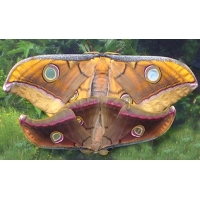
Tussore Silkmoth Antheraea mylitta India
For years this species has been difficult to obtain.
A large silkmoth, one of India’s largest, noted for its great variety of colour forms and for the cocoon which is large, smooth and oval, very much like a hen’s egg, and with a long silk stalk which the caterpillar spins to anchor the cocoon to the branch for the winter. Mylitta sometimes emerges rather late in the season. Warmth and lots of humidity may be used to induce earlier emergence.
In India the cocoons are reeled to produce the renowned Wild Tussore (Tusseh, Tassar) Silk. The dried cocoons are boiled for several hours with sodium hydroxide to dissolve the strong adhesive sericin that binds the silk together in it's smooth and unique egg-like shape.
This species can be a challenge to rear. The larvae feed on Oak, but they also feed on Sumac Rhus typhina, Osier Willow, Eucalyptus and undoubtedly other trees. We have found that they do well sleeved if the weather is good. Otherwise in indoors warm conditions, starting in plastic rearing containers, then in cages. Cleanliness is essential.
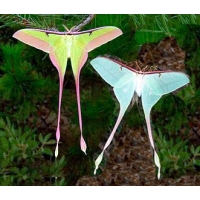
Actias dubernardi China
This is a species that is very difficult to obtain.
The moths are most delicate and have exceptionally long tails for their size. Male and female are differently coloured (the male is the pink and yellow one).
The larvae feed exclusively on Pine, amongst which they are extrordinarily well camouflaged. Young larvae mimic the Pine make catkins. Larger larvae are easily lost among the Pine needles, yet they are contrastingly marked and patterned with bright spangles, and startling colours between the segments.
This is a must for the serious breeder!
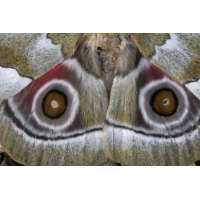
Gonimbrasia zambezina Africa
Subterranean pupa. Stock fresh in from Africa. The moth is large and beautifully marked in shades of grey, red and yellow, with prominent eye-spots. Foodplants need confirming but larvae may take to several different trees. These have been reported: Oak, Oleander, Persimmon, Sumac & Brazilian Pepper.