
CURRENT PUPAE - Chrysalides and cocoons
If you are a beginner and need information on rearing from small caterpillars, or hatching out pupae, please order the All Colour Paperback BUTTERFLIES. INSTRUCTIONS ARE NOT SENT WITH EACH SPECIES, you need to acquire basic skills and this book is a simple way of doing so.
Please Select a Category Below:
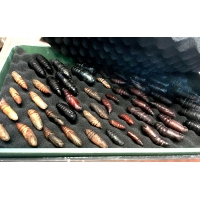
PUPAE NEST
The Pupae Nest, using sheets of bobble foam, is the innovative method used by WWB to keep subterranean pupae, in particular, and other pupae and cocoons in ideal conditions in the emerging cage.
• Developed specifically for underground pupae: also ideal for cocoons and unattached pupae.
• Immediate access to pupae for inspection, without disturbance.
• Provides healthy and moist conditions.
• Easy observation of pupae that are forming up prior to emergence.
• Allows the breeder to anticipate the emergence of required males or females.
• Ensures hygiene and avoidance of harmful bacteria.
This method has proved to be better than using soil or compost, because it enables instant inspection whenever required, for removal of empty pupal shells or any dead pupae, and to be able clean up, with minimum disturbance of the pupae. The pupae rest in the depressions, in natural conditions of humidity and hygiene. If they were on plain foam sheets they would roll around, and would be less able to benefit from the humidity assisted by the depressions, which also provide separation. The covering sheet of foam is placed with the bobble side down, so both of the indented sides are together, which allows some airflow and eases the passage for adults to emerge and climb to dry their wings.

The Pupae Nest is based on standard seed tray size 24 x 38 cms which fits the Standard Pyjama Cage.
Cocoons also do well resting on a bobble foam sheet, usually without another sheet covering them, though in exceptionally hot conditions, a moist foam sheet on top of the cocoons, helps to maintain humidity. Cocoons require very liberal watering, not a just a fine mist. Soak them thoroughly, safe in the knowledge that they are well drained.
If already moist when you next come to spray, you can reduce or omit further spraying. The pupae and foam should be sprayed thoroughly (not just misted) every day, or more often in higher temperatures. If already very moist when you next come to spray, you can reduce or omit that day's spraying. The base of the upper tray is perforated to allow drainage. It rests in an unperforated tray with a block to separate the two trays and receive the drained water. This drainage allows liberal watering, without risk of the pupae lying in water.
Cocoons also do well resting on a bobble foam sheet, usually without another sheet covering them, though in exceptionally hot conditions, a moist foam sheet on top of the cocoons, helps to maintain humidity. Cocoons require very liberal watering, not a just a fine mist. Soak them thoroughly, safe in the knowledge that they are well drained.
Butterfly pupae, which in the wild are not formed underground, are usually fixed to a twig or other surface, either hanging from the tail cremaster, or (dependent on their family) upright and held in place by a silken girdle. You can go to the trouble of emulating this artificially (the way to suspend pupae is described in the Exotic Butterfly Pupae section) or they can be laid on the surface of the foam and not covered. As long as they are misted to avoid them drying out, the butterfly usually forms successfully in such pupae laid on foam, and the porous surface helps give the emerging butterfly the grip needed to pull itself out of the chrysalis shell, and crawl to the netting wall of the cage to expand and dry its wings.
From time to time, it is good practice to remove the pupae, wash the foam thoroughly, spray with dilute bleach (about 10% solution, which is not harmful to the pupae) then replace the pupae on nice wet foam. In summer the foam is normally washed about every 2- 3 weeks, using hot water with a touch of bleach added, but without soap or detergent which would create problems with froth and would take too long to rinse away. The washing interval depends on the extent of hatching activity and temperature. Any hint of smell, or slippery feel to the pupae, indicates bacteria, and means that washing is overdue. When adults emerge from the pupa, a waste product Meconium, is ejected. This is only harmful if left so long that it spoils the freshness and encourages bacteria. Empty pupal shells and any other organic matter, are best frequently removed, to avoid build-up of mould or bacteria. In the emerging cage, pupae that are crowded together can develop a slime, caused by bacteria, which slows development and can kill pupae. Pupae nests help to eliminate such risk and periodic washing gives maximum hygiene.
When washing the foam sheets, it is also important to wash and disinfect the two trays. If you are incubating quite a lot of pupae it makes it more convenient to have two Pupae Nests, so you can move the pupae straight into a prepared clean Nest. To encourage this, there is a price reduction for two nests bought together.
TO INCUBATE pupae and COCOONS An emerging cage should have netting sides with plenty of ventilation. This provides grip for emerging adults, and you can add some sticks. In summer conditions, you can incubate temperate pupae at room temperature, without further heating, but when it is cool you may wish to add warmth. When you heat, the ambient temperature can be raised to 25º over a few days, and increase further to 30º if required. The air around the cage needs to be heated: they don’t do so well if heat is directed at the pupae or the cage. Don't stand the cage on a heat source. You cannot over-water the cocoons as long as they are able to drain. You can hang cocoons: if you do they then need more frequent and heavy watering. Exotic butterfly pupae should be incubated, totally shaded, in a tropical greenhouse. The ambience of a tropical greenhouse is not easy to emulate. Some breeders are successful in re-creating such conditions, but it us not sufficient simply to achieve a high temperature and humidity. For details of how to attach tropical butterfly pupae to twigs, or bamboo, please see the introduction to the Exotic Butterfly section of the WWB website. Exotic butterfly pupae that are not suspended but lying loose, can be laid on the bobble foam of a Pupae Nest, and left uncovered. Remember incubating pupae must always be in full shade.
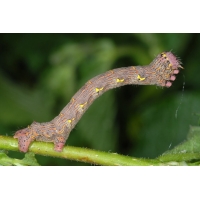
Brindled Beauty Lycia hirtaria
Not often available. Larvae ready from May.
Once a common Geometer, now quite a find! The larvae are stick-like "loopers" quite prettily decorated and very active when not resting to resemble a twig.
The larvae accept a wide variety of tree foliage which includes, Oak, Birch, Lime, Hawthorh, Willows, Sallows, Alder and Cherry.
Pupation is underground, where they rest for the winter. The moths fly in late winter and springtime.

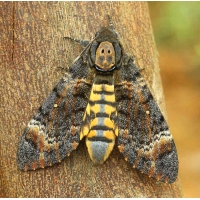
Asian Deathshead Hawkmoth Acherontia styx Asia
This is the first time ever offered by WWB! This is a unique opportunity to rare this much sought-after species!
Acherontia styx occurs from Arabia eastward to Thailand. Closely related to the Deathshead found in Africa and Europe, the two species are distinguished by the thoracic skull, which in styx is a darker suffused orange, rather than the yellow skull seen on atropos. In styx the forewing discal spot is yellow, and in atropos it is white.
Larvae of both species are very varied in colouring and shade, often brought about by choice of foodplant and available light. Both are known to have a proportion of dark brown forms, though most are shades of green and yellow, sometimes tinged with blue.
In captivity Privet is usually the most convenient foodplant. The larvae are also recorded as accepting Ash, Jasmines, Potato and most other Solanaceae, Clerodendrum, Grapevine and even Lantana. Like atropos, the larvae will sometimes accept unexpected foodplants!
Both species are continuously brooded, but the pupae can be held in cooler conditions for longer than in nature, waiting for the warmer spring conditions. This happens naturally in Southern Europe.
Our thanks to A. R. Pittaway for allowing the use of some of his photographs of this species.
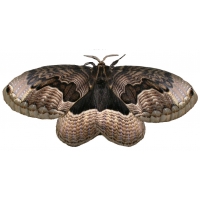
Siberian Owl Moth Brahmaea lunulata South Eastern Russia and China
Some authors consider this a close cousin of Brahmaea certhia and others consider this as a synonym of Brahmaea tancrei. Regardless of the finer points of its taxonomy, this is a very interesting and different Brahmaeid with very dark and bold markings, and the larvae are just fascinating in all stages.
The most practical foodplant for Brahmaea lunulata is Privet. They are also known to accept Lilac, Ash, Olive and probably will accept other closely related foodplants.
Newly hatched larvae have disproportionately long wavy spines, almost as long as their body! As the larvae grow, they take on a greyish pink hue, still with the typical Brahmaea spines or tubercles. They develop fast if kept warm. At the final skin change, the appendages are shed with the skin, and the final instar larva is overall an orange grey, heavily peppered. They pose, sphinx-like in a defensive mode, when they are not stretched out feeding voraciously!
Let them pupate on a layer of compost, with flat stones or tiles, beneath which they pupa is formed. Do not disturb the pupae until fully hardened, which takes more than just a few days. Although a second brood is known, lunulata, normally remains as a dormant pupa through the winter.
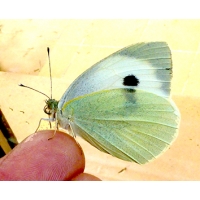
Large White Butterfly Pieris brassicae
TEN pupae £29.90 now on special offer £20.95
No longer the common butterfly it once was. Summer pupae may hibernate, especially if chilled, and some will emerge to give a further generation.
Winter pupae are stored cool and normally hatch in May, though some occasionally develop during winter if not cold enough.
This is a good species for the inexperienced, and as an introduction to rearing larvae.
The larvae feed on cabbage but also most Cruciferae which can be better and less smelly for captive rearing! Horseradish is ideal for its large leaves and other species include Nasturtium, Rape, Mustard, Sweet Rocket, Turnip and Watercress.
There are two or more generations in a year.
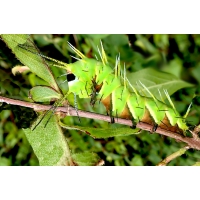
Eastern Glory Moth Mirina christophi Korea, Amur and Far South Eastern Russia
A little-known species that has many characteristics of the Silkmoths Saturniidae, but surprisingly is in fact in the same family as the Kentish Glory Endromis versicolora!
This very attractive species occurs in few localities in Korea and northwards to Amur. Not many people get to visit those parts!
The larvae feed on Honeysuckle and Weigelia. Young larvae undergo changes in form and colouring with each skin change, eventually becoming most handsome, very large and decorated with multi-coloured spines and tubercles, with every appearance akin to the Horned Devils of the New World.
A bulbous cocoon is spun, where the pupa overwinters, to produce the adult in spring.
The simplicity of the adult moth is a stark contrast with the very exotic and variable larvae. For an Endromid the bulbous silk cocoon is a big surprise!
This is a must-have species for the curious breeder - an opportunity not to be missed!
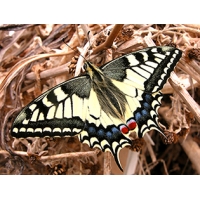
European Swallowtail Papilio machaon gorganus
Very difficult to obtain, there are seldom enough to meet demand. Keep winter pupae refrigerated until late April. Lay the pupae on foam sheet in the base of a netting emerging cage. Spray in hot weather. The butterflies normally emerge in May/June.
For breeding, the butterflies require some space, nectar flowers and growing foodplant. They need sunlight and humidity. Give them a shady area in the cage. Eggs are laid on the foodplant leaves.
The larvae are very easy to rear on Fennel, Carrot leaves and Parsnip leaves and flowers (wild and cultivated). One of the most attractive butterfly larvae and a joy to rear!
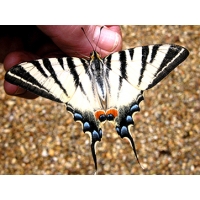
Scarce Swallowtail Iphiclides podalirius
Good size, plump and clear colour. Increasingly difficult to obtain. The larvae feed on Blackthorn. Most people find this species difficult to breed but it is a joy to have them emerge at home, and worth trying to breed.
Scarce Swallowtail Iphiclides podalirius
Good size, plump and clear colour. Increasingly difficult to obtain. The larvae feed on Blackthorn. Most people find this species difficult to breed but it is a joy to have them emerge at home, and worth trying to breed.

Black Swallowtail Papilio polyxenes asterias North America
Very closely related to the European and British swallowtails, asterias will often hybridise with either, producing interesting offspring.
The collections of 4 pupae comprise 3 male and a female pupa for breeding.
The larvae feed on Fennel, Carrot tops, and some other Umbelliferae including wild and probably cultivated Parsnip. Two broods are produced in the year and the pupae of the second brood hibernate.

Tiger Swallowtail Papilio glaucus North America
The Tiger Swallowtail is perhaps North America’s grandest swallowtail. As a curiosity, a small proportion of females emerge as melanics, not as beautiful as the typical female, but different! They can be bred in captivity and the larvae are as exotic as many of the tropical swallowtails, with the Papilio eye markings and bird dropping camouflage in the early instars.
Try feeding them on Cherry, Ash or Lime, and they will probably take a wider variety of foodplants.
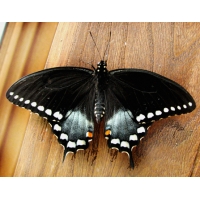
Spicebush Swallowtail Papilio troilus North America
A large swallowtail from the Eastern parts of North America. The larvae, which have wonderful enlarged eye markings, feed on Spicebush Lindera benzoin and Sassafras Sassafras albidum, Camphor Cinnamomum camphora, and Redbay Persea borbonia, perhaps prickly ash Zanthoxylum americanum. In Europe they are bred on Tulip Tree Liriodendron and Sweetbay Magnolia virginiana. There are two generations. Store winter pupae refrigerated in a plastic box, until May.
On the back of the thorax on the pupa, there is a curious pattern in the exact image of a butterfly, even with curly antennae!