
SPRING and SUMMER EGGS and LARVAE Order now for supply in season
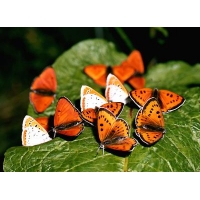
Large Copper Butterfly Lycaena dispar batavus Larvae
Now MOST DIFFICULT TO OBTAIN! This is a rare opportunity!
These larvae will produce adults this summer.
This is the large and richly coloured Large Copper which originated from Freisland in Holland and is almost indistinguishable from the extinct British Large Copper Lycaena dispar dispar.
Common Dock is an acceptable foodplant, though if you have their natural foodplant Great Water Dock Rumex hydropathalum, that is even better. It has also been reported to us that the larvae seem to prefer Rumex patientia if offered! They can be reared in plastic boxes on fresh foodplant that is changed daily, but they do best, and are less trouble if you can pot up young fresh plants and keep the larvae on these, either in cages or covered with a sleeve. The larvae grow fast.
Pupae are formed on the stems or sides of the cage. The first sight of the newly emerged butterflies is absolutely breath-taking! July larvae may produce another partial brood if kept warm. Otherwise they go into hibernation.

The Common Blue Polyommatus icarus
This Blue is probably the most wide-spread of all the Blues. The bright sky-blue of the male is familiar to most people. The larvae feed on Birdsfoot Trefoil, Medick, Rest Harrow and other Leguminosae.
The larvae are very small. If you are not an experienced breeder it would be better to choose one of the easier species to rear.
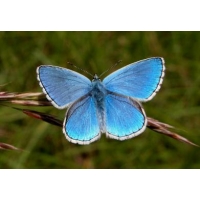
The Adonis Blue Lysandra bellargus
The intense blue iridescence of the male is unmatched in Europe. The female has a rich burnt umber colouring. To raise the larvae you need Horseshoe vetch Hippocrepis comosa, a low-growing plant, covered with yellow flowers in May, requiring calcareous soil. The larvae, which will also feed on Coronilla, feed rapidly and pupate among the base of the foodplant. In Britain the Adonis is double brooded, the adults flying in June and August.
The larvae are very small. If you are not an experienced breeder it would be better to choose one of the easier species to rear.
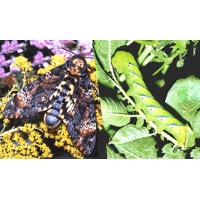
Deathshead Hawkmoth Acheronia atropos
For international destinations please order LARVAE (a separate product)
Everyone’s favourite. In a massive operation most booked orders have now been supplied, and we can now supply new orders. An extreme rarity, migrating to Britain from Africa. Occasionally the larvae are found in potato fields but that’s if you are lucky and these days with modern machinery the chances of larvae being found are even more remote. There is a world shortage of Deathshead in captivity, but our breeders now have superb wild stock, which is being very productive. Orders for pupae will be supplied this summer, as well as eggs and larvae now.
The most convenient foodplant is Privet Ligustrum, which is evergreen. Recorded alternative foodplants for atropos larvae include Potato, Deadly Nightshade, Bittersweet Solanum dulcamara, and most other Solanaceae, Ash, Jasmines including evergreen, Lilac, Buddleia, Chilli Pepper Capsicum, Olive, Tree Tobacco Nicotiana glauca and possibly other Nicotiana.
The duration of the egg stage is just a few days, and the larvae grow probably twice as fast as our native hawkmoth larvae, completing their life cycle in as little as 4-6 weeks in summer temperatures. These larvae will produce another generation of moths within weeks of pupation, but you can keep them cool in the winter months, and have them emerge in spring.
The moth is just amazing to have alive on your hand! It is furry, and squeaks – almost like handling a little mammal. It also humps its back and displays the blue markings on the body, as well as the famous skull and crossbones on the thorax. The moth needs to feed, not from flowers but from a pad soaked in weak honey or sugar solution. Moths have been found inside beehives, attracted by the sweet smell of honey.
In summer, the pupae will emerge within about 4 weeks. In autumn, to overwinter, bury the pupae in light compost that is not too damp but not allowed to dry out. The top of each pupa should be just showing. Store in a cool place (10-15 degrees C) away from predadors. Bring into the warm in April ready for May emergence.
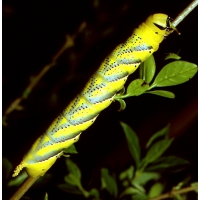
Deathshead Hawkmoth Acheronia atropos
Larvae for GB addresses ready in first half of September. Larvae for Europe will be sent from the second half of the month.
Everyone’s favourite. An extreme rarity, migrating to Britain from Africa. Occasionally the larvae are found in potato fields but that’s if you are lucky and these days with modern machinery the chances of larvae being found are even more remote.
The larvae feed on many plants in the potato family, Solanaceae, but you don’t have to have these to keep the larvae: they do well on Privet. They have also been found feeding on Buddleia, resulting in a pale coloured larva that matches the leaves, but this is not a recommended foodplant.
The duration of the egg stage is just a few days, and the larvae grow probably twice as fast as our native hawkmoth larvae, completing their life cycle in as little as 4-6 weeks in summer temperatures. These larvae will produce another generation of moths within weeks of pupation, but you can keep them cool in the winter months, and have them emerge in spring.
The moth is just amazing to have alive on your hand! It is furry, and squeaks – almost like handling a little mammal. It also humps its back and displays the blue markings on the body, as well as the famous skull and crossbones on the thorax. The moth needs to feed, not from flowers but from a pad soaked in weak honey or sugar solution. Moths have been found inside beehives, attracted by the sweet smell of honey.
In summer, the pupae will emerge within about 4 weeks. In autumn, to overwinter, bury the pupae in light compost that is not too damp but not allowed to dry out. The top of each pupa should be just showing. Store in a cool place (10-15 degrees C) away from predadors. Bring into the warm in April ready for May emergence.
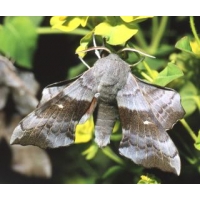
Poplar Hawkmoth Laothoe populi
Fast growing, the larvae feed on most Willows and Poplars. They do well in sleeves or caged.
This is one of the few hawkmoths that produce two broods of moths in the year.
The larvae become very fat and vary in both the ground colour, in shades of green or blue/green, and in their markings which often include red spots as well as the oblique stripes down the sides.
The larvae need to burrow into compost for pupation.

Lime Hawkmoth Mimas tiliae
THRIVING LARVAE at about HALF PRICE! Limited time offer.
Extremely easy to rear on Lime or Elm. Other reported foodplants include Cherry, Alder, Birch, Oak, Hazel, Acer including Sycamore, Sorbus, Apple, Pear and Ash! In autumn the larvae will grow faster if kept warm.
The larvae do particularly well sleeved on growing foodplant but can be kept in plastic boxes or cages. Beautiful streamlined larvae. Larger larvae are often heavily marked with flame and scarlet spots and blotches. Very variable. They pupate underground. In captivity they will pupate amongst folds of cloth or absorbent tissue. Store pupae refrigerated for the winter. The moths normally emerge in May/June.
Lime Hawkmoth Mimas tiliae
Extremely easy to rear on Lime or Elm. Other reported foodplants include Cherry, Alder, Birch, Oak, Hazel, Acer including Sycamore, Sorbus, Apple, Pear and Ash! In autumn the larvae will grow faster if kept warm.
The larvae do particularly well sleeved on growing foodplant but can be kept in plastic boxes or cages. Beautiful streamlined larvae. Larger larvae are often heavily marked with flame and scarlet spots and blotches. Very variable. They pupate underground. In captivity they will pupate amongst folds of cloth or absorbent tissue. Store pupae refrigerated for the winter. The moths normally emerge in May/June.

Lime Hawkmoth Mimas tiliae
Extremely easy to rear on Lime or Elm. Other reported foodplants include Cherry, Alder, Birch, Oak, Hazel, Acer including Sycamore, Sorbus, Apple, Pear and Ash! In autumn the larvae will grow faster if kept warm.
The larvae do particularly well sleeved on growing foodplant but can be kept in plastic boxes or cages. Beautiful streamlined larvae. Larger larvae are often heavily marked with flame and scarlet spots and blotches. Very variable. They pupate underground. In captivity they will pupate amongst folds of cloth or absorbent tissue. Store pupae refrigerated for the winter. The moths normally emerge in May/June.
Lime Hawkmoth Mimas tiliae
Extremely easy to rear on Lime or Elm. Other reported foodplants include Cherry, Alder, Birch, Oak, Hazel, Acer including Sycamore, Sorbus, Apple, Pear and Ash! In autumn the larvae will grow faster if kept warm.
The larvae do particularly well sleeved on growing foodplant but can be kept in plastic boxes or cages. Beautiful streamlined larvae. Larger larvae are often heavily marked with flame and scarlet spots and blotches. Very variable. They pupate underground. In captivity they will pupate amongst folds of cloth or absorbent tissue. Store pupae refrigerated for the winter. The moths normally emerge in May/June.
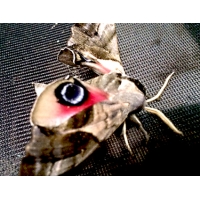
Eyed Hawk Smerinthus ocellata
Fascinatingly camouflaged larvae which exactly match their leafy background. Easy to breed.
The larvae feed on Apple, Willows, Poplars. Other reported foodplants are Lime, Privet, Alder, Birch, Plum, Blackthorn, some Viburnums, Various Prunus, Laurel.
At pupation time, provide a container of compost to a depth of about 10cm, with a lid. The larvae burrow to pupate. The moths, with vivid eye-spots, emerge the following spring.

Eyed Hawk Smerinthus ocellata
Fascinatingly camouflaged larvae which exactly match their leafy background. Easy to breed.
The larvae feed on Apple, Willows, Poplars. Other reported foodplants are Lime, Privet, Alder, Birch, Plum, Blackthorn, some Viburnums, Various Prunus, Laurel.
At pupation time, provide a container of compost to a depth of about 10cm, with a lid. The larvae burrow to pupate. The moths, with vivid eye-spots, emerge the following spring.