
WINTER PUPAE for breeding in the following season
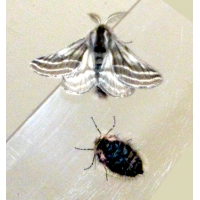
The Belted Beauty Lycia zonaria
In Britain this species is very rare indeed, and protected. Found in only about 3 localities on sandy nutrient-poor grassland or dunes. Very scarce in Holland, where it occurs in similar coastal areas. Our stock comes from central Europe, where it is sometimes found on dry limestone slopes where the vegetation is sparse.

Eggs are laid in batches particularly on grasses where they can be tucked into pockets and hollow stems. The larvae feed on a variety of vegetation - possibly almost anything that is growing amongst the grasses. They are recorded as feeding on Dandelion, Dock, Cow Parsley,Clovers, Kidney Vetch, Bird’s-foot Trefoil, Yarrow, Creeping Willows and Sallows, Hawthorn, Coltsfoot, Plantains, Burnet Rose and even Flag Iris. The larva, starting black with prominent white spots, becomes medium green, well camouflaged colour, but with a prominent lemon yellow lateral stripe. This is a Geometer - looper caterpillar. This is one of the few moths that has a wingless female. The female rests sometimes prominently where they more easily attract males, which fly by day and by night.
The pupa is formed only a little below the ground surface, where it spends the winter. Store winter pupae in a closed plastic box, very cool or refrigerated. To avoid desiccation don't leave in open air. In the emerging cage, keep moist at all times. See the Pupae Nest on this website. Emergence starts in the very early spring.
This is an opportunity not to be missed, to breed a very rare species and see its life history at first hand.
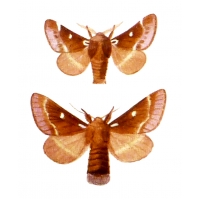
Small Eggar Moth Eriogaster lanestris
The moths emerge in March/April. On receipt of the pupae they should be refrigerated until spring. The moths form inside the cocoon in late winter. The moment the temperature rises, they burst forth, and it is inadvisable to let them do this too early, or any fertile eggs might hatch before there is any foodplant.
Because of modern practice of hedge management, this once common species is nowadays a rare find. Tight clipping of hedges destroys the habitat and undoubtedly the eggs and larvae.
Egg clusters are laid in batches, covered with black fluff from the tip of the female's abdomen, on branches of the foodplant Blackthorn Prunus spinosa or Hawthorn Crataegus monogyna. The larvae cluster, and even large larvae live within, and on the outsite of a prominent white tent of silk, very often at the end of a branch, with no attempt at concealment. It is likely that the larvae in captivity could be reared on Apple and Plum, though we have not tried these.
Don't be tempted to handle the larvae. They have short, decorative hairs, which easily come away and if they penetrate the skin, like short cactus prickles, this can give rise to intense irritation. No doubt this is why the larvae can afford to display themselves in the wild so openly. No predator will try to eat them once they learn, and the larvae are patterned in warning colours to advertise the danger.
To pupate, the larvae descend to form a tight cocoon with a smooth shell-like a nut, in concealed leaf litter or moss, where they spend the winter. In early spring, the moths are fully formed within the pupal shell, ready to emerge the moment they sense that conditions are right. If you take the nut-like cocoons from the cold and put them into room temperature, the moths will suddenly break open the ends of the cocoons and there will be a whole lot of moths in a very short time!
You might help to spread the species locally if you can find thorn hedges that are not regularly trimmed. Cocoons are immediately available. Keep them in the fridge until April. You will enjoy observing this species, in all its interesting stages, and maybe could introduce it to your area.
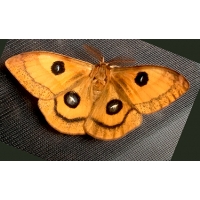
Tau Emperor Aglia tau
This European Silkmoth emerges about the same time as the Emperor Moth, in early spring, and is in the same family of Silkmoths (Saturniidae). Very easy to breed: lay the pupae out in February for March/April emergence. The moths fly and pair by day, and particularly appreciate sunshine. Eggs are laid on the cage sides.
The young larvae are adorned with antlers, as impressive as the American Hicory Horned Devils! Foodplants include Lime, Oak, Birch, Hawthorn, and other trees and shrubs. Pupation is in leaf litter. Single brooded.
Highly recommended.
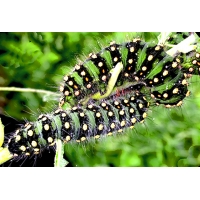
Emperor Moth Saturnia pavonia
Britain’s only Silkmoth. The male and female have similar markings, but the female is larger, and the male is more brightly coloured.
Emergence is in March/April. Pairing is easy – if you have a female, she may attract males from miles away. The Emperor Moth occurs in many rural areas but is particularly found on heaths, where they breed on Heathers. The larvae feed on a variety of plants, including Bramble, Raspberry, Hawthorn, Blackthorn, Apple, Plum, Blackthorn, Oak, Hornbeam, Birch, Heathers and Heaths, Blueberry, Meadowsweet, Wild Rose, Sea Buckthorn, Purple Loosestrife, Willows especially Osier Salix viminalis, Pussy Willow (Sallow).
The caterpillars cluster in the early instars, eventually spreading out and becoming brightly coloured, as beautiful as such exotics as the Moon Moths. The cocoon is spun in the foodplant. An interesting construction with a neck and open end, through which the adult emerges.
Store cocoons in a plastic box in a fridge until March. The moths normally emerge in April.
This is one of the fun species to rear. Demand for this species is high. Please order early.
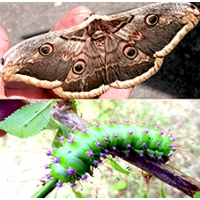
Giant Peacock Moth Saturnia pyri
Magnificent - Europe’s largest moth. Flies in May, pairs easily and lays prodigiously. Exotic looking larvae.
Rear the larvae in warm, dry conditions. They are very easy to rear in the first instars and extra care is needed to bring them through the final instars. They repay proper care, growing fast and changing colour.
The large larva is as handsome as the tropical Saturniidae and has much in common with Moon Moth larvae, but with sapphire blue tubercles. They do well on Blackthorn and Plum and will often feed on other fruit trees and Hawthorn, Willows, Alder and Birch.

Ligurian Emperor Moth Saturnia pavoniella
Ten cocoons normally £28.95 NOW 22.95!
Slightly larger than our Emperor. A joy to breed: with amazingly varied larvae, quite distinct from Emperor larvae.
Although the moth is similar to our Emperor Moth pavonia, pavoniella male has a paler band on the hindwing inner margin. There are other differences in appearance and the intensity of pattern, particularly in the male.
Large larvae are quite distinct from those of pavonia, and very diverse in their colouring (see pictures). Foodplants are the same as for pavonia and include Apple, Plum, Blackthorn, Bramble, Hawthorn, Heather, Willow, Birch, and many others. Pavoniella females pair several times (pavonia only once). The two species hybridise easily but the progeny of hybrids of pavonia with pavoniella are infertile, which indicates that pavoniella is a true species. Pavoniella is found in central Europe, extending south to Greece and for some distance into Turkey and well into Asia Minor.
Pairing is very easy in sunshine. Rearing the larvae is most rewarding and interesting. Do give this species a try!
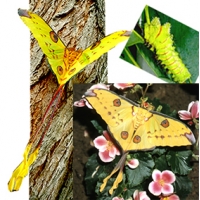
Madagascan Moon Moth Argema mittrei
There is no other species in the world like this beautiful and graceful giant! Mittrei occurs only on the island of Madagascar, and it is a privilege to be able to have this amazing species to breed at home in captivity. If this huge Moon Moth were to decline its loss would equate with the loss of the Dodo. Don't overlook the opportunity to experience Argema mittrei at first hand. It may not always be possible!
Huge netted cocoons of silvery silk – THE biggest cocoon in the world!
Both male and female moths are tailed but those of the male are very extreme. They are a joy to hatch out!
They need daily spraying and a temperature of 25-30 degrees C. Pairing of the adults is notoriously difficult but if successful, the larvae are not difficult to rear on Eucalyptus, Liquidambar or Stags Horn Sumach Rhus typhinus. Hand-pairing has been reported to be successful but we have not tried it.
Mittrei is found only on the island of Madagascar and is quite one of the word's most exceptional moths.

Giant Atlas Moth Attacus atlas
There is a shortage this winter. We are sending out as and when received.
The largest moth in the world. Winter cocoons are dormant. You can choose whether to incubate them or keep them cold until the spring. To get them to emerge, raise the temperature to 15 degrees C, and gradually up to 30 degrees C or more, and very humid. They need very warm and humid tropical conditions. When hot, soak the cocoons at least once or twice daily.
It is probably better to keep them cool (8 -12 degrees C) and dormant until mid-April, or even May, then raise the temperature and humidity as described above. They will respond better to summer conditions.
Pairing is achieved in a cage that is ample for the size of the moths but not so large that they can become too separated.
Larvae feed on Privet Ligustrum and are easily reared in warm and moist conditions. Atlas larvae will also feed on Tree of Heaven Ailanthus, Osier Willow Salix viminalis, Citrus and undoubtedly a number of other substitute plants outside their normal habitat.
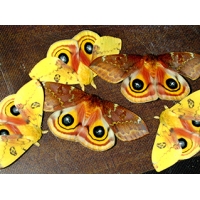
Bullseye Moth Automeris io North America
This small silkmoth has a number of interesting characteristics. The male and female are distinctly different colours – both have the enormous eye markings on the hindwings which are exposed when the moth is disturbed. The larvae are covered by branched spines – don’t touch them – they sting like a nettle. They are gregarious until the larvae are quite large, changing colour at each skin change. Very interesting and easy to rear.
For pairing, keep the moths in a cage the size of the Pyjama Mini Cage. Fertile eggs develop a black dot which is the micropyle, through which the embryo breathes. A useful indicator of fertility, not present in most other species.
The larvae are polyphagous, ie they will accept a wide variety of foodplants, which include such trees as Oak, Lime, Willow, Hazel, Bramble, Apple, Hawthorn and more.
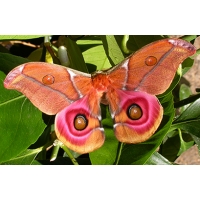
Madagascan Emperor Antherina suraka
Not only is the moth highly colourful and attractive, but the larvae are also most interesting, having an almost infinite number of different colour forms.
The moths pair as easily as pernyi (!) and lay lots of eggs.
The larvae are easy to keep indoor or sleeved out in summer weather, and will take a variety of foodplants. Those reported include Oleander, Privet, Willows, Beech, Liquidambar, Hawthorn, Grapevine, Lilac, Cherry, Laurel, Forcythia, Rhus, Pistachia, Apple, Pear, Plum, Peach and Cabbage.
We highly recommend this species.

American Moon Moth Actias luna North America
A very attractive Moon Moth that emerges from May and breeds exceptionally easily. The larvae feed well on Walnut, Birch, Osier Willow, Liquidambar, Plane, Maples, Aspen, Plum, Sallow, Several kinds of Oak and maybe other foodplants.
A second brood is produced in late summer. Winter is passed in the cocoon stage. Store them cold from November until April. May is the normal emergence time for the first brood.