
SPRING and SUMMER PUPAE You can order these NOW in advance
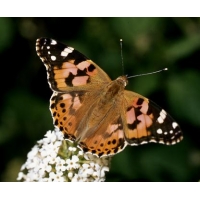
Painted Lady Vanessa cardui
Most years Painted Lady pupae are not available. This year we are expecting supplies again. PLEASE ORDER EARLY!
In Europe this is a migrant butterfly from N. Africa and it is probably the only butterfly found on every continent of the world. Larval foodplants include Nettle and Thistle but they also take a variety of other herbaceous plants including Mallow and Burdock.
This is a continuously brooded species that is available at intervals during the summer.

Comma Butterfly Polygonia c-album
A chance to breed this attractive British butterfly, or to reinforce local populations by releasing the adultd. Fascinating larvae with curious half and half markings in black, brown and white, mimicking a bird dropping. The larvae feed on Stinging Nettle, Elm and Hop. They live singly. Fast growing.
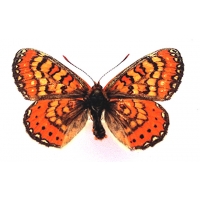
Beckeri Marsh Fritillary Euodrydryas aurinia beckeri
This is the most magnificent form of the Marsh Fritillary – very large, boldly marked and the brightest colouring and pattern of all. Beckeri occurs in parts of Spain, Portugal and North Africa. This stock is from Portugal. The larvae feed on Honeysuckle, Snowberry, and some Knapweeds and Scabious. Pupae are due in April. Supplies will be limited.

Glanville Fritillary Melitaea cinxia
The larvae feed on Narrow-leaved Plantain, and live in a cluster until large. These pupae will produce butterflies in a short time.
Glanville Fritillary Melitaea cinxia
The larvae feed on Narrow-leaved Plantain, and live in a cluster until large. These pupae will produce butterflies in a short time.
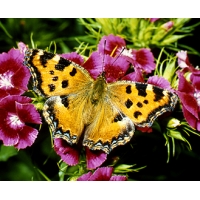
Large Tortoiseshell Nymphalis polychloros
One of Europe’s grand butterflies! Now believed to be extinct in Britain.
The larvae feed on a variety of fruit trees, Willow, Sallow, Elms, Aspen, Poplars and Birches. Easy to rear, particularly when sleeved on growing foodplant, but protect from excessive rain. Butterflies are produced this year. They feed on nectar, sap and fruit, then hibernate until they breed in spring.
Could you help establish this extinct British species in your area?

Long-tailed Blue Lampides boeticus Europe

Livestock is seldom available. This is a scarce migrant to Britain. The larvae live inside the flowers and seed pods of Broom, Pea, and almost any Leguminosae (Papilionaceae)
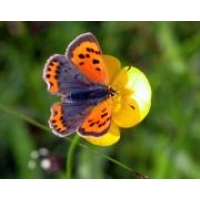
Small Copper Butterfly Lycaena phlaeas
The pupae of this species are seldom offered. The larvae feed on common Dock and Sorrel. Butterflies will be produced almost immediately.
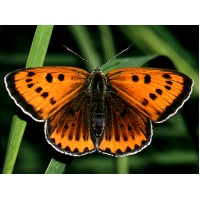
Large Copper Butterfly Lycaena dispar batavus
This is the large and richly coloured Large Copper which originated from Freisland in Holland and closely resembles the extinct British Large Copper. Common Dock is an acceptable foodplant, though if you have their natural foodplant Great Water Dock, that is even better. They can be reared in plastic boxes on fresh foodplant that is changed daily, but they do best, and are less trouble if you can pot up young fresh plants and keep the larvae on these, either in cages or covered with a sleeve. The larvae grow fast. Pupae are formed on the stems or sides of the cage. The first sight of the newly emerged butterflies is absolutely breath-taking! July larvae may produce another partial brood if kept warm. Otherwise they go into hibernation.
This species has now become very difficult to obtain.
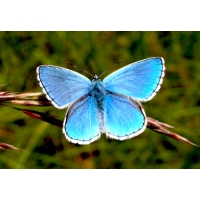
The Adonis Blue Lysandra bellargus
The intense blue iridescence of the male is unmatched in Europe. The female has a rich burnt umber colouring. To raise the larvae you need Horseshoe vetch Hippocrepis comosa, a low-growing plant, covered with yellow flowers in May, requiring calcareous soil. The larvae, which will also feed on Coronilla, feed rapidly and pupate among the base of the foodplant. In Britain the Adonis is double brooded, the adults flying in June and August.
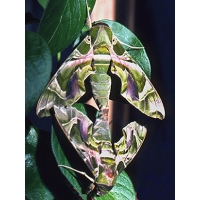
Oleander Hawkmoth Daphnis nerii
One of the finest of all Hawkmoths. They can be bred in captivity. The larvae are very fast growing indeed. Most breeders rear the larvae on Privet Ligustrum. The larvae thrive on Periwinkle Vinca, and in the wild they are found on Oleander Nerium.
Pupae can be kept warm (20ºC) and moist to emerge this autumn/winter, or they can be kept cool to emerge and breed in the spring.
To overwinter autumn pupae, bury the pupae in light compost that is not too damp but not allowed to dry out. The top of each pupa should be just showing. Store in a cool place (10-12 degrees C) away from predadors. Bring into the warm in April ready for May emergence.
In the emerging cage, underground pupae need to be in moist compost or kept as described for the Pupae Nest on this website.
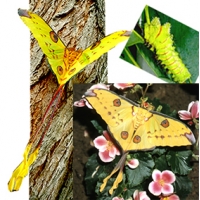
Madagascan Moon Moth Argema mittrei
There is no other species in the world like this beautiful and graceful giant! Mittrei occurs only on the island of Madagascar, and it is a privilege to be able to have this amazing species to breed at home in captivity. If this huge Moon Moth were to decline its loss would equate with the loss of the Dodo. Don't overlook the opportunity to experience Argema mittrei at first hand. It may not always be possible!
Huge netted cocoons of silvery silk – THE biggest cocoon in the world!
Both male and female moths are tailed but those of the male are very extreme. They are a joy to hatch out!
They need daily spraying and a temperature of 25-30 degrees C. Pairing of the adults is notoriously difficult but if successful, the larvae are not difficult to rear on Eucalyptus, Liquidambar or Stags Horn Sumach Rhus typhinus. Hand-pairing has been reported to be successful but we have not tried it.
Mittrei is found only on the island of Madagascar and is quite one of the word's most exceptional moths.