
SCHOOLS Recommended Livestock
If you are a beginner and need information on rearing from small caterpillars, or hatching out pupae, please order the All Colour Paperback BUTTERFLIES. INSTRUCTIONS ARE NOT SENT WITH EACH SPECIES, you need to acquire basic skills and this book is a simple way of doing so. Please read the Plastic Rearing Container section for advice on rearing young caterpillars which must have nursery treatment while they are not large enough to be kept in cages. This information is enlarged upon in the paperback guide referred to above.
We do not invoice: please use school or personal credit card to order on this website, and reclaim with the invoice printed from your account.Thank you.

Eyed Hawk Smerinthus ocellata
Fascinatingly camouflaged larvae which exactly match their leafy background. Easy to breed.
The larvae feed on Apple, Willows, Poplars. Other reported foodplants are Lime, Privet, Alder, Birch, Plum, Blackthorn, some Viburnums, Various Prunus, Laurel.
At pupation time, provide a container of compost to a depth of about 10cm, with a lid. The larvae burrow to pupate. The moths, with vivid eye-spots, emerge the following spring.
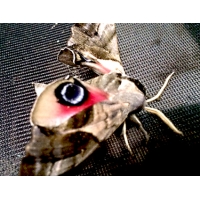
Eyed Hawk Smerinthus ocellata
Fascinatingly camouflaged larvae which exactly match their leafy background. Easy to breed.
The larvae feed on Apple, Willows, Poplars. Other reported foodplants are Lime, Privet, Alder, Birch, Plum, Blackthorn, some Viburnums, Various Prunus, Laurel.
At pupation time, provide a container of compost to a depth of about 10cm, with a lid. The larvae burrow to pupate. The moths, with vivid eye-spots, emerge the following spring.

Puss Moth Cerura vinula
An ideal beginner's species and an old favourite for the connoisseur. Larvae change frequently and become one of the strangest creatures. Curious forked tail with long red flagellae when disturbed. Foodplants are Poplars and Willows.
The caterpillar spins a concrete-hard cocoon of chewed bark, mixed into its own silk, producing a cocoon that is so camouflaged that it is very hard to see - see the picture - VERY hard to see!
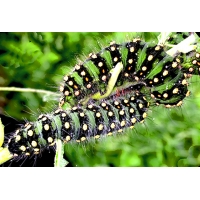
Emperor Moth Saturnia pavonia
Britain’s only Silkmoth. The male and female have similar markings, but the female is larger, and the male is more brightly coloured. The Emperor Moth occurs in many rural areas but is particularly found on heaths, where they breed on Heathers. Eggs are laid in clusters on the heather, looking just like the dead flowerheads from last year.
The larvae feed on a variety of plants, including Bramble, Raspberry, Hawthorn, Blackthorn, Apple, Plum, Blackthorn, Oak, Hornbeam, Birch, Heathers and Heaths, Blueberry, Meadowsweet, Wild Rose, Sea Buckthorn, Purple Loosestrife, Willows especially Osier Salix viminalis, Pussy Willow (Sallow).
The caterpillars cluster in the early instars, eventually spreading out and becoming brightly coloured, as beautiful as such exotics as the Indian Moon Moth. The cocoon is spun in the foodplant. This is the stage that passes the winter. An interesting construction with a neck and open end, through which the adult emerges in spring. This is one of the fun species to rear.
Store cocoons in a cupboard until November. Then keep refrigerated until mid- February when they can be put in the emerging cage ready for hatching in March.
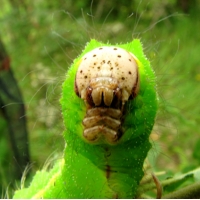
Chinese Silkmoth Antheraea pernyi
Highly recommended for those who are looking for a spectacular moth, with LARGE exotic larvae: easily reared.
This species used to be universally available. Over the years captive bred stocks have disappointingly become in-bred. We now have strong wild Chinese stock. s
A large species, and undoubtedly the best for beginners. Moths emerge in the spring. They pair very easily.
Very easy to keep. Young larvae are black, and later turn green. They become enormous, feeding on Oak, Birch, Sweet Chestnut, Horse Chestnut, Prunus, Hornbeam (Carpinus), Apple, Hawthorn, Beech, Osier Willow. After about 2 months the larvae spin silk cocoons - an extra opportunity for a teaching project. Moths emerge the same year. Autumn larvae spin over-wintering cocoons.
Larvae thrive on Evergreen Oak when other plants not available. In winter, if the evergreen leaves are a bit leathery, make some incisions in the leaves with scissors. This releases attractive scent to the larvae and and gives them easier places to start feeding.
A PERFECT species for children and beginners!
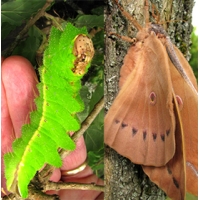
Chinese Silkmoth Antheraea pernyi
Highly recommended for those who are looking for a spectacular moth, with LARGE exotic larvae: easily reared.
This species used to be universally available. Over the years captive bred stocks have disappointingly become in-bred. We now have strong wild Chinese stock.
A large species, and undoubtedly the best for beginners. Moths emerge in the spring. They pair very easily.
Very easy to keep. Young larvae are black, and later turn green. They become enormous, feeding on Oak, Birch, Sweet Chestnut, Horse Chestnut, Prunus, Hornbeam (Carpinus), Apple, Hawthorn, Beech, Osier Willow. After about 2 months the larvae spin silk cocoons - an extra opportunity for a teaching project. Moths emerge the same year. Autumn larvae spin over-wintering cocoons.
Larvae thrive on Evergreen Oak when other plants not available. In winter, if the evergreen leaves are a bit leathery, make some incisions in the leaves with scissors. This releases attractive scent to the larvae and and gives them easier places to start feeding.
A PERFECT species for children and beginners!