
Special Offers

Pure Silk hanks These are English reeled 20/22 Denier raw silk hanks produced at the Lullingstone Silk Farm and Worldwide Butterflies.
These fine silk hanks were reeled on the same hand reeling machine, the only one in
The size and weight not standard but the illustration shows a hank picked at random. This is a unique product!
Special temporary promotion price.

NETTING Fine black/grey Nylon 5 metres 120 cm wide
Ideal for covering box tops, cages, netting replacement and making sleeves. This soft netting is ideal for making field nets.
Durable, resists tearing and deterioration in UV light. It is fine enough to keep out all but the minutest flies and parasites.
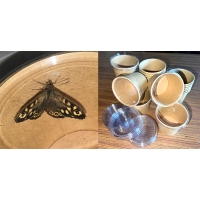
FIELD COLLECTING BOXES A new and welcome aid for field studies.
Snap-on clear lids make these ideal for collecting breeding females, larvae and all sorts of beetles, bugs and flies. Suitable too for small moth laying containers.
Clear vision for identification, lightweight and stackable. TWENTY boxes for an amazingly low price!
Dimensions: Height 55mm, diameter 66mm top, 45mm base.

NETTING Fine black/grey Nylon 10 metres 120cm wide
If you are thinking of making a netting structure, cage covering and replacement or making sleeves for rearing larvae, this is the ideal netting.
Durable, resists tearing and deterioration in UV light. It is fine enough to keep out all but the minutest flies and parasites.

NETTING Fine black/grey Nylon 20 metres (2 x 10m) 120cm wide.
Ideal for large structures, flight areas etc.
Use for cage covering or making sleeves for rearing larvae.
Durable, resists tearing and deterioration in UV light. It is fine enough to keep out all but the minutest flies and parasites.

Marsh Fritillary Eurydryas aurinia
The butterflies fly from May into June. Eggs are laid in large clusters on the underside of Devil’s Bit Scabious.The larvae Feed on Honeysuckle (wild is best), Teasel Snowberry or the natural foodplant Devil’s Bit Scabious. The larvae live in a tightly formed web, growing only a little before they hibernate in autumn.

Marsh Fritillary Eurydryas aurinia
The butterflies fly from May into June. Eggs are laid in large clusters on the underside of Devil’s Bit Scabious.The larvae Feed on Honeysuckle (wild is best), Snowberry or the natural foodplant Devil’s Bit Scabious. The larvae live in a tightly formed web, growing only a little before they hibernate in autumn.

Marsh Fritillary Eurodryas aurinia
SPECIAL PRICE FOR 20 Larvae!
Larvae feed low amongst the leaves of Devil’s Bit Scabioius, but will also eat Honeysuckle. Honeysuckle starts leafing very early in the year, especially where sheltered in woodland. By February it is not diffficult to find enough foodplant to keep caterpillars well fed. In captivity the larvae are recorded as accepting Ribwort Plantain Plantago lanceolata, Teasel Dipsacus and Snowberry Symphoricarpos.
Pre-hibernation larvae might be induced to develop and produce another generation with long day-length and sufficient warmth.
After waking in the spring the larvae grow fast, pupating in April and emerging as butterflies in May.
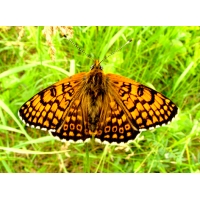
Glanville Fritillary Melitaea cinxia
Feed on Narrow-leaved Plantain. Easiest to keep on potted foodplant, enclosed in a sleeve. The larvae are gregarious, living in a tight bunch at the base of the plant, and spreading out more as they grow larger. The ginger head capsule and jet black body distinguish these larvae from other species.
In Britain this species lives mainly on the Isle of Wight coast, but they have been established elsewhere in Britain. Maybe they could be encouraged in more localities.
These larvae will produce butterflies this spring.
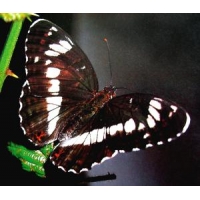
White Admiral Limenitis camilla
Demand will is great for this popular species, whose livestock is very difficult to obtain.
The caterpillar lives solitarily at the tip of a Honeysuckle leaf. When tiny it decorates itself with its own dried droppings which gives it effective camouflage.
As well as Honeysuckle, in captivity larvae can be reared on Snowberry Symphoricarpus albus and may also accept hedging Honeysuckle Lonicera nitida.
In warm years there may be two generations.
Later the caterpillar constructs an individual hibernaculum at the end of the leaf, which it rolls up to form its winter quarters.
The solitary larva takes up position on the leaf main stem, eating and growing, until it hangs up to pupate in June.
Store the hibernacula in a plastic box in a cool place. Honeysuckle leafs early so be ready as early as January/February.

Long-tailed Blue Lampides boeticus Europe

Livestock is seldom available. This is a scarce migrant to Britain. The larvae live inside the flowers and seed pods of Broom, Pea, and almost any Leguminosae (Papilionaceae)
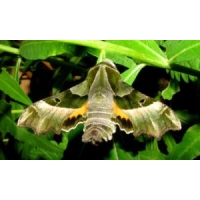
Willowherb Hawkmoth Proserpinus proserpina
SCARCE! Only a few pupae available.
This rather rare Hawkmoth is a gem, seldom encountered, though it lives throughout much of western and central Europe, eastwards into Russia.
The larva is rather like a grey form of Small Elephant Hawk. The foodplant is Rosebay Willowherb Epilobium, Evening Primrose Oenothera and Purple Loosetrife Lythrum. The pretty little green moth has prominent egg-yolk coloured hindwings. The normal flight period is June and July.