
MARKET STALL Everything a BARGAIN!
Small numbers only. First come first served!
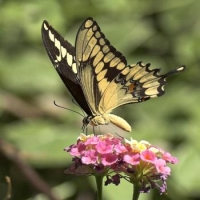
The Giant Swallowtail Papilio cresphontes North America
SPECIAL OFFER 5 Pupae normally £55.00, NOW only £39.95!
This is North America's largest butterfly. An impressive broad-winged Swallowtail as fine as any tropical species. The Giant Swallowtail will breed in captivity. The larvae, which are knarled and resemble a bird dropping, feed on Rutaceae: Citrus, Rue and probably Choisya, as well as Zanthotoxylum.

Marsh Fritillary Eurodryas aurinia
SPECIAL PRICE FOR 20 Larvae!
Larvae feed low amongst the leaves of Devil’s Bit Scabioius, but will also eat Honeysuckle. Honeysuckle starts leafing very early in the year, especially where sheltered in woodland. By February it is not diffficult to find enough foodplant to keep caterpillars well fed. In captivity the larvae are recorded as accepting Ribwort Plantain Plantago lanceolata, Teasel Dipsacus and Snowberry Symphoricarpos.
Pre-hibernation larvae might be induced to develop and produce another generation with long day-length and sufficient warmth.
After waking in the spring the larvae grow fast, pupating in April and emerging as butterflies in May.
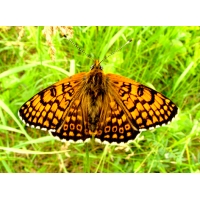
Glanville Fritillary Melitaea cinxia
Feed on Narrow-leaved Plantain. Easiest to keep on potted foodplant, enclosed in a sleeve. The larvae are gregarious, living in a tight bunch at the base of the plant, and spreading out more as they grow larger. The ginger head capsule and jet black body distinguish these larvae from other species.
In Britain this species lives mainly on the Isle of Wight coast, but they have been established elsewhere in Britain. Maybe they could be encouraged in more localities.
These larvae will produce butterflies this spring.
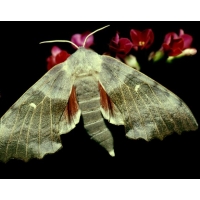
Poplar Hawk Laothoe populi
These pupae will produce moths this year when given warmth and watering.
The moth has a curious resting position, with hindwings projecting in front of the forewings. Patterned in shades of grey, this large Hawkmoth escapes detection because of its curious shape.
Two broods are produced in May and July/August. The larvae are very robust, bright green, with stripes and sometimes red spots. Sleeved larvae do best, on Poplars, Willows and Sallows.
Very easy to breed.

Lime Hawkmoth Mimas tiliae
Extremely easy to rear on Lime or Elm. Other reported foodplants include Cherry, Alder, Birch, Oak, Hazel, Acer including Sycamore, Sorbus, Apple, Pear and Ash! In autumn the larvae will grow faster if kept warm.
The larvae do particularly well sleeved on growing foodplant but can be kept in plastic boxes or cages. Beautiful streamlined larvae. Larger larvae are often heavily marked with flame and scarlet spots and blotches. Very variable. They pupate underground. In captivity they will pupate amongst folds of cloth or absorbent tissue. Store pupae refrigerated for the winter. The moths normally emerge in May/June.
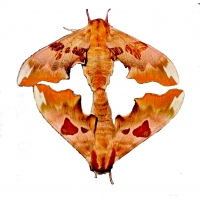
Lime Hawk tiliae BRICK RED VARIETY
This rare aberration has BRICK RED colouring all over . Both parents are the BRICK RED, and a good proportion of the progeny should follow. These adults are also producing BANDED and ONE SPOT vars.
Extremely easy to rear on Lime or Elm. Other reported foodplants include Cherry, Alder, Birch, Oak, Hazel, Acer including Sycamore, Sorbus, Apple, Pear and Ash! In autumn the larvae will grow faster if kept warm.

The larvae do particularly well sleeved on growing foodplant but can be kept in plastic boxes or cages. Beautiful streamlined larvae. Larger larvae are often heavily marked with flame and scarlet spots and blotches. Very variable. They pupate underground. In captivity they will pupate amongst folds of cloth or absorbent tissue. Store pupae refrigerated for the winter. The moths normally emerge in May/June.
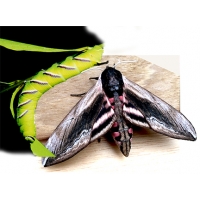
Privet Hawk Sphinx ligustri
One of the largest Hawkmoths. Keep pupae cool for breeding in summer.
The caterpillar becomes enormous and is characteristic of the name Sphinx moths, by its sphinx-like resting position. Adults emerge in June and July. They need nectar from the flowers of Privet, Valerian, Buddleia.
Larval foodplants: Privet, Lilac, Ash, also reportedly Spiraea, Viburnum opulus, and other Viburnums, Holly, Dogwood, Snowberry, Apple, Pear, Oleander, Leycesteria, Currant.
One generation in the year. Privet Hawks breed readily in a large cage with nectar and foodplant.
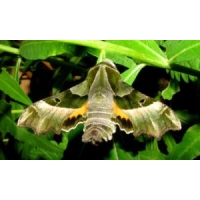
Willowherb Hawkmoth Proserpinus proserpina
SCARCE! Only a few pupae available.
This rather rare Hawkmoth is a gem, seldom encountered, though it lives throughout much of western and central Europe, eastwards into Russia.
The larva is rather like a grey form of Small Elephant Hawk. The foodplant is Rosebay Willowherb Epilobium, Evening Primrose Oenothera and Purple Loosetrife Lythrum. The pretty little green moth has prominent egg-yolk coloured hindwings. The normal flight period is June and July.
Willowherb Hawkmoth Proserpinus proserpina
SCARCE! Only a few pupae available.
This rather rare Hawkmoth is a gem, seldom encountered, though it lives throughout much of western and central Europe, eastwards into Russia.
The larva is rather like a grey form of Small Elephant Hawk. The foodplant is Rosebay Willowherb Epilobium, Evening Primrose Oenothera and Purple Loosetrife Lythrum. The pretty little green moth has prominent egg-yolk coloured hindwings. The normal flight period is June and July.
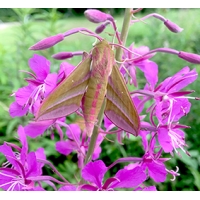
Elephant Hawk Dielephila elpenor
TEN PUPAE normally £39.95 NOW £37.95
Store winter pupae refrigerated in a plastic box. In the emerging cage it is important to have the pupae moist but well drained. Please see the Pupae Nest on this website. The moths usually emerge in June and July.
Cage the moths with nectar flowers and springs of Willowherb – you do not see the pairings but fertile eggs are easily obtained.
An exceptionally pretty moth with amazing and characterful larvae, with eye-spots and probing “trunks”. Young larvae are green, later changing to charcoal black, with occasional rarities remaining green.
Larvae feed on Willowherbs, Fuschia, Creepers.
Highly recommended.
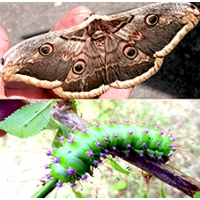
Giant Peacock Moth Saturnia pyri
Magnificent - Europe’s largest moth. Flies in May, pairs easily and lays prodigiously. Exotic looking larvae.
Rear the larvae in warm, dry conditions. They are very easy to rear in the first instars and extra care is needed to bring them through the final instars. They repay proper care, growing fast and changing colour.
The large larva is as handsome as the tropical Saturniidae and has much in common with Moon Moth larvae, but with sapphire blue tubercles. They do well on Blackthorn and Plum and will often feed on other fruit trees and Hawthorn, Willows, Alder and Birch.
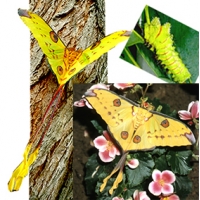
Madagascan Moon Moth Argema mittrei
There is no other species in the world like this beautiful and graceful giant! Mittrei occurs only on the island of Madagascar, and it is a privilege to be able to have this amazing species to breed at home in captivity. If this huge Moon Moth were to decline its loss would equate with the loss of the Dodo. Don't overlook the opportunity to experience Argema mittrei at first hand. It may not always be possible!
Huge netted cocoons of silvery silk – THE biggest cocoon in the world!
Both male and female moths are tailed but those of the male are very extreme. They are a joy to hatch out!
They need daily spraying and a temperature of 25-30 degrees C. Pairing of the adults is notoriously difficult but if successful, the larvae are not difficult to rear on Eucalyptus, Liquidambar or Stags Horn Sumach Rhus typhinus. Hand-pairing has been reported to be successful but we have not tried it.
Mittrei is found only on the island of Madagascar and is quite one of the word's most exceptional moths.