
WINTER PUPAE for breeding in the following season
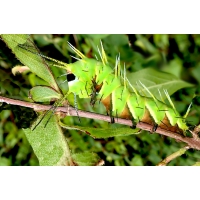
Eastern Glory Moth Mirina christophi Korea, Amur and Far South Eastern Russia
A little-known species that has many characteristics of the Silkmoths Saturniidae, but surprisingly is in fact in the same family as the Kentish Glory Endromis versicolora!
This very attractive species occurs in few localities in Korea and northwards to Amur. Not many people get to visit those parts!
The larvae feed on Honeysuckle and Weigelia. Young larvae undergo changes in form and colouring with each skin change, eventually becoming most handsome, very large and decorated with multi-coloured spines and tubercles, with every appearance akin to the Horned Devils of the New World.
A bulbous cocoon is spun, where the pupa overwinters, to produce the adult in spring.
The simplicity of the adult moth is a stark contrast with the very exotic and variable larvae. For an Endromid the bulbous silk cocoon is a big surprise!
This is a must-have species for the curious breeder - an opportunity not to be missed!
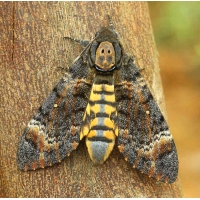
Asian Deathshead Hawkmoth Acherontia styx Asia
This is the first time ever offered by WWB! This is a unique opportunity to rare this much sought-after species!
Acherontia styx occurs from Arabia eastward to Thailand. Closely related to the Deathshead found in Africa and Europe, the two species are distinguished by the thoracic skull, which in styx is a darker suffused orange, rather than the yellow skull seen on atropos. In styx the forewing discal spot is yellow, and in atropos it is white.
Larvae of both species are very varied in colouring and shade, often brought about by choice of foodplant and available light. Both are known to have a proportion of dark brown forms, though most are shades of green and yellow, sometimes tinged with blue.
In captivity Privet is usually the most convenient foodplant. The larvae are also recorded as accepting Ash, Jasmines, Potato and most other Solanaceae, Clerodendrum, Grapevine and even Lantana. Like atropos, the larvae will sometimes accept unexpected foodplants!
Both species are continuously brooded, but the pupae can be held in cooler conditions for longer than in nature, waiting for the warmer spring conditions. This happens naturally in Southern Europe.
Our thanks to A. R. Pittaway for allowing the use of some of his photographs of this species.
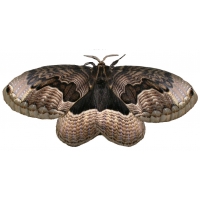
Siberian Owl Moth Brahmaea lunulata South Eastern Russia and China
Some authors consider this a close cousin of Brahmaea certhia and others consider this as a synonym of Brahmaea tancrei. Regardless of the finer points of its taxonomy, this is a very interesting and different Brahmaeid with very dark and bold markings, and the larvae are just fascinating in all stages.
The most practical foodplant for Brahmaea lunulata is Privet. They are also known to accept Lilac, Ash, Olive and probably will accept other closely related foodplants.
Newly hatched larvae have disproportionately long wavy spines, almost as long as their body! As the larvae grow, they take on a greyish pink hue, still with the typical Brahmaea spines or tubercles. They develop fast if kept warm. At the final skin change, the appendages are shed with the skin, and the final instar larva is overall an orange grey, heavily peppered. They pose, sphinx-like in a defensive mode, when they are not stretched out feeding voraciously!
Let them pupate on a layer of compost, with flat stones or tiles, beneath which they pupa is formed. Do not disturb the pupae until fully hardened, which takes more than just a few days. Although a second brood is known, lunulata, normally remains as a dormant pupa through the winter.
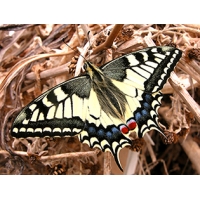
European Swallowtail Papilio machaon gorganus
Very difficult to obtain, there are seldom enough to meet demand. Keep winter pupae refrigerated until late April. Lay the pupae on foam sheet in the base of a netting emerging cage. Spray in hot weather. The butterflies normally emerge in May/June.
For breeding, the butterflies require some space, nectar flowers and growing foodplant. They need sunlight and humidity. Give them a shady area in the cage. Eggs are laid on the foodplant leaves.
The larvae are very easy to rear on Fennel, Carrot leaves and Parsnip leaves and flowers (wild and cultivated). One of the most attractive butterfly larvae and a joy to rear!
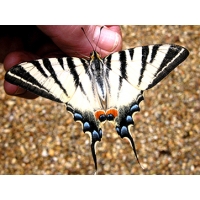
Scarce Swallowtail Iphiclides podalirius
Good size, plump and clear colour. Increasingly difficult to obtain. The larvae feed on Blackthorn. Most people find this species difficult to breed but it is a joy to have them emerge at home, and worth trying to breed.
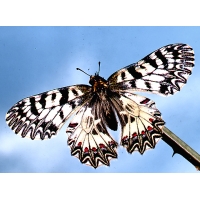
The Festoon Zerynthia polyxena Europe
A delicate spring butterfly in the Swallowtail family Papilionidae.
The terrain for this charming species is in mountains, usually lower than 2000m. The species is widely dispursed in southern and eastern Europe and in Russia, seldom occurring in large numbers in any one locality. The Festoon is found in the French and Italian Alps, northwards through Austria to the Czech Republic and Slovakia. It is also found in the mountains of Greece and Bulgaria, Belarus and several mountain ranges in Russia.
The larvae (which are like minatures of Birdwing larvae) feed on Birthwort Aristolochia clematitis, A. rotunda and other local Aristolochia. If you don't have Aristolochia you can search on the internet where plants are for sale.
Store the pupae cold for the winter months. The adults normally emerge from May. There is only one generation in the year.


Black Swallowtail Papilio polyxenes asterias North America
Very closely related to the European and British swallowtails, asterias will often hybridise with either, producing interesting offspring.
The collections of 4 pupae comprise 3 male and a female pupa for breeding.
The larvae feed on Fennel, Carrot tops, and some other Umbelliferae including wild and probably cultivated Parsnip. Two broods are produced in the year and the pupae of the second brood hibernate.

Tiger Swallowtail Papilio glaucus North America
The Tiger Swallowtail is perhaps North America’s grandest swallowtail. As a curiosity, a small proportion of females emerge as melanics, not as beautiful as the typical female, but different! They can be bred in captivity and the larvae are as exotic as many of the tropical swallowtails, with the Papilio eye markings and bird dropping camouflage in the early instars.
Try feeding them on Cherry, Ash or Lime, and they will probably take a wider variety of foodplants.
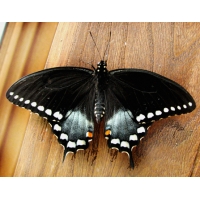
Spicebush Swallowtail Papilio troilus North America
A large swallowtail from the Eastern parts of North America. The larvae, which have wonderful enlarged eye markings, feed on Spicebush Lindera benzoin and Sassafras Sassafras albidum, Camphor Cinnamomum camphora, and Redbay Persea borbonia, perhaps prickly ash Zanthoxylum americanum. In Europe they are bred on Tulip Tree Liriodendron and Sweetbay Magnolia virginiana. There are two generations. Store winter pupae refrigerated in a plastic box, until May.
On the back of the thorax on the pupa, there is a curious pattern in the exact image of a butterfly, even with curly antennae!
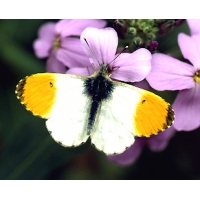
Orange Tip Anthocharis cardamines Europe
Normally 5 for £28.95 NOW £23.95, 10 for £56.95 NOW £39.95
Store the pupae in a cool place, for the winter, even a refrigerator, loose in a plastic box. An early spring butterfly. Depending on locality and season, the butterflies usually begin to fly in May. The male has the orange tips. Both sexes have mottled undersides in green which is actually made of microscopic scales of black and yellow, giving the illusion of green. The curious pupae look like thorns.
Eggs are laid on Garlic Mustard, Sweet Rocket and Cuckoo Flower or Lady’s Smock. The larvae live singly and are canabalistic. Not difficult to breed, particularly on potted foodplant. Camouflage in all stages is remarkable.
This species breeds prodigiously in the new FREEDOM CAGES! Please see them in the CAGES section.
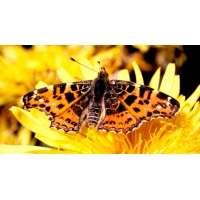
Map Butterfly Araschnia levana
A charming and quite small Vanessid butterfly that occurs throughout much of Europe but not in the British Isles. It has been established in Britain but the colony was deliberately destroyed. This is a nettle feeder.
The eggs are laid in unique pendant strings from the underside of a nettle leaf. Younger larvae are gregarious.
There are normally two broods: the spring brood is patterned rather like a fritillary, as illustrated. In July the second brood (form porosa) emerges looking like miniature White Admirals!
An established British colony was deliberately exterminated. Why not try again?
Pairing is not easy but success is more likely if you can create a netting sleeve that brings the two sexes together, like the peak of a hood. Second brood larvae hang up to pupate in secluded places for the winter. The pupae we are offering now are to be stored in a cool outhouse or fridge until April. Then lay them out for emergence in April/May.
Map Butterfly Araschnia levana
A charming and quite small Vanessid butterfly that occurs throughout much of Europe but not in the British Isles. It has been established in Britain but the colony was deliberately destroyed. This is a nettle feeder.
The eggs are laid in unique pendant strings from the underside of a nettle leaf. Younger larvae are gregarious.
There are normally two broods: the spring brood is patterned rather like a fritillary, as illustrated. In July the second brood (form porosa) emerges looking like miniature White Admirals!
An established British colony was deliberately exterminated. Why not try again?
Pairing is not easy but success is more likely if you can create a netting sleeve that brings the two sexes together, like the peak of a hood. Second brood larvae hang up to pupate in secluded places for the winter. The pupae we are offering now are to be stored in a cool outhouse or fridge until April. Then lay them out for emergence in April/May.