
Current EGGS and LARVAE
If you are a beginner and need information on rearing from small caterpillars, or hatching out pupae, please order the All Colour Paperback BUTTERFLIES. INSTRUCTIONS ARE NOT SENT WITH EACH SPECIES, you need to acquire basic skills and this book is a simple way of doing so.

Lime Hawkmoth Mimas tiliae
THRIVING LARVAE at about HALF PRICE! Limited time offer.
Extremely easy to rear on Lime or Elm. Other reported foodplants include Cherry, Alder, Birch, Oak, Hazel, Acer including Sycamore, Sorbus, Apple, Pear and Ash! In autumn the larvae will grow faster if kept warm.
The larvae do particularly well sleeved on growing foodplant but can be kept in plastic boxes or cages. Beautiful streamlined larvae. Larger larvae are often heavily marked with flame and scarlet spots and blotches. Very variable. They pupate underground. In captivity they will pupate amongst folds of cloth or absorbent tissue. Store pupae refrigerated for the winter. The moths normally emerge in May/June.
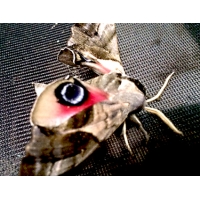
Eyed Hawk Smerinthus ocellata
Fascinatingly camouflaged larvae which exactly match their leafy background. Easy to breed.
The larvae feed on Apple, Willows, Poplars. Other reported foodplants are Lime, Privet, Alder, Birch, Plum, Blackthorn, some Viburnums, Various Prunus, Laurel.
At pupation time, provide a container of compost to a depth of about 10cm, with a lid. The larvae burrow to pupate. The moths, with vivid eye-spots, emerge the following spring.
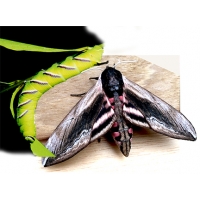
Privet Hawkmoth Sphinx ligustri
A real favourite! These are quite one of Britain’s largest and grandest caterpillars.
Start young larvae in plastic boxes (see advice under Plastic Rearing Containers on this site). Later they can be sleeved if the weather is warm and not too wet. Alternatively cage the larvae on cut food in water (stuff the mouth of the jar to prevent drowning), or you can use a sleeve in place of a cage.
The caterpillar becomes enormous and is characteristic of the name Sphinx moths, by its sphinx-like resting position. When ready to pupate, the larvae become a bruised apple brown colour and start to wander. At this stage, collect them and put in a plastic tub with about 100 cm of soil or compost in the bottom, and some leaf litter on top. The larvae burrow and pupate in the compost. Leave for two weeks to harden, then carefully bring them to the surface and store them in a plastic box for the winter. From late December keep them refrigerated until May, when they can be put in the emerging cage. Please read the way of keeping underground pupae in the emerging cage, as outlined under Pupae Nest on this website.
Adults emerge in June and July. They need nectar from the flowers of Privet, Valerian, Buddleia.
Larval foodplants: Privet, Lilac, Ash, also reportedly Spiraea, Viburnum opulus, and other Viburnums, Holly, Dogwood, Snowberry, Apple, Pear, Oleander, Leycesteria, Currant.
One generation in the year. Privet Hawks breed readily in a large cage with nectar and foodplant.
The large pupae are formed underground. Store the pupae cold for emergence next summer.
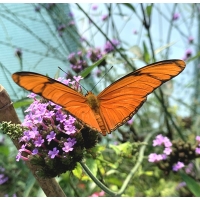
Dryas julia from Central America
Slender wings and vitality characterise this attractive butterfly, related to the Heliconius species, and normally breeds as easily.
The larvae feed on Passiflora.
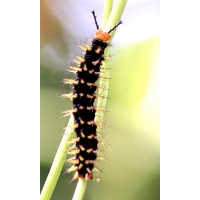
Hypolimnas bolina Tropical Asia.
When explorers first encountered this butterfly they were hugely excited by the iridescent blue and white markings. This is indeed one of the most beautiful tropical butterflies, even though quite widespread and common. The larvae can be reared on stinging nettle! a
The female is larger than the male, with different patterning in blue, white and orange on black.
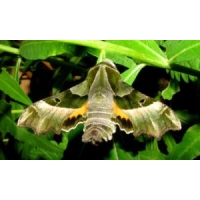
Willowherb Hawkmoth Proserpinus proserpina
SCARCE! Only a few pupae available.
This rather rare Hawkmoth is a gem, seldom encountered, though it lives throughout much of western and central Europe, eastwards into Russia.
The larva is rather like a grey form of Small Elephant Hawk. The foodplant is Rosebay Willowherb Epilobium, Evening Primrose Oenothera and Purple Loosetrife Lythrum. The pretty little green moth has prominent egg-yolk coloured hindwings. The normal flight period is June and July.
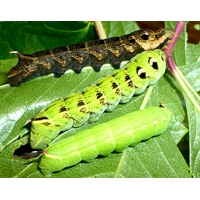
Elephant Hawk Dielephila elpenor
A most attractive and easy species to rear. The larvae feed on Willowherbs, Fuschia, Virginia Creeper, Vine and Bedstraw. Fast-growing, the larvae have two colour forms, starting green they change to black, or a lovely green form, the green being the rarest.
The larvae pupate amongst leaf litter on the ground, and emerge next spring as one of the most beautiful of all hawkmoths.

Kentish Glory Endromis versicolora
The larvae, black at first, cluster on the twigs. Later they are green and spread out a little, clinging on to the twigs, they look just like Birch catkins. Absolute masters of camouflage. Birch is the normal foodplant, but the larvae can also be reared on Hazel, Alder, Hornbeam, and Lime.
This species is now found only in Scotland, and parts of Central Europe. Our stock is European.
Rearing of Kentish Glory larvae is very easy, indoors or outside, and they do particularly well sleeved on their foodplant. In May/June the larvae pupate in leaf litter and soil and settle down until the new season starts again in February. This is a very easy species.
The male and female moths share the same patterning, but the female is much larger and the male has particularly rich chestnut markings. Pairing is easy. Provide twigs of foodplant, on which to lay. At this time there are no leaves. Just leave the moths together pairing and egg-laying take place naturally.The Eggs are the first of the season to be laid in February and March. They are yellow when laid, later turning maroon in colour, matching the twigs they are laid on. Keep the eggs cool until you have the first leaves of foodplant.
Our thanks to Jens Stolt who has kindly allowed us to use his beautiful illustration of the life history of this rare species.

Oleander Hawk Daphnis nerii
Because the egg stage is only a few days, they cannot be supplied outside Britain.
One of the finest of all Hawkmoths. The larvae are very fast growing indeed and they consume a lot of food. It is often possible to have the larvae from hatching to pupation in little more than a month.
Larvae thrive on Privet and can be reared on Periwinkle Vinca, or Honeysuckle Lonicera. Suitable for winter or summer rearing. Oleander Nerium is a natural foodplant but it is often tough and leathery, so the alternives are usually better than Oleander.
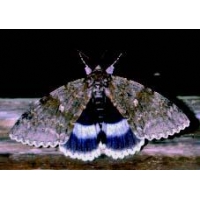
Clifden Nonpareil (Blue Underwing) Catocala fraxini
The largest underwing, spectacular blue. Store eggs refrigerated until May.
This species is now almost extinct in Britain. We are offering European stock of this fine moth, the largest of all Underwings and remarkable for its BLUE hindwings. The young larvae are immensely active and care must be taken when transferring them to fooplant on hatching, because they can tangle themselves up if you try to move more than one at a time! Feed on Aspen and other Poplars. The larvae are the largest of this genus and very satisfying to rear. Moths emerge in late summer, laying eggs that overwinter.
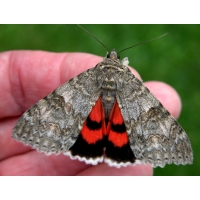
Red Underwing Catocala nupta
A large and very grand species, with the most wonderful scarlet underwings which are flashed from beneath its grey exterior when disturbed. The larvae feed on Poplars and Willows (Osier is ideal). When they hatch, use a soft artist’s brush to transfer the larvae on to fresh Poplar in a plastic box. Within a few days, we recommend that the larvae are sleeved on growing foodplant, which can be potted or growing outside. The larvae are well camouflaged on the Poplar stems. After becoming quite large, they pupate amongst leaf litter and produce moths in late summer. Eggs are laid on bark and in captivity they will usually lay on netting, preferably double, coarse mesh. The eggs overwinter, so keep them in the fridge until spring.
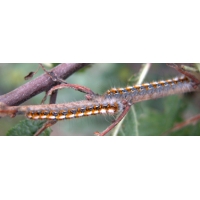
Oak Eggar Lasiocampa quercus
The largest of the Eggars. Larvae grow before hibernation. Very easily kept sleeved out, both before, during and after hibernation. Foodplants Privet, Birch, Hazel, Alder, Lilac, Willow, Sallow, Aspen Poplar, Bramble, Blackcurrant, Heather, Blackthorn, Plum, Blueberry, Sea Buckthorn and Apple.