
Current EGGS and LARVAE
If you are a beginner and need information on rearing from small caterpillars, or hatching out pupae, please order the All Colour Paperback BUTTERFLIES. INSTRUCTIONS ARE NOT SENT WITH EACH SPECIES, you need to acquire basic skills and this book is a simple way of doing so.

Tau Emperor Moth Aglia tau
This European Silkmoth flies in early spring and is one of the Silkmoths (Saturniidae).
The young larvae are adorned with antlers, as impressive as the American Hicory Horned Devils! Foodplants include Lime, Oak, Birch, Hawthorn, and other trees and shrubs.
Pupation is in leaf litter. Single brooded. Highly recommended. Very easy to breed: lay the pupae out in February for March emergence. The moths fly and pair by day, and particularly appreciate sunshine. Eggs are laid on the cage sides.

Madagascan Moon Moth Argema mittrei
10 Eggs normally £25.95 now £19.95 LIMITED TIME OFFER!
20 Eggs normally £51.90 now £29.95
Eggs of this huge Moon Moth are the largest we have ever seen. See the photo of one compared to other Giant Silkmoth eggs!
Eggs are sent direct from our breeder in Holland.
The larvae like warmth but not excessive temperature: likewise humidity but not too much. They feed well on Liquidambar, Eucalyptus gunii, Rhus typhina and Rhus glabra.
Huge netted cocoons of silvery silk – probably the biggest cocoon in the world! Both male and female moths are tailed but those of the male are very extreme.
This is a species that the connoisseur should not miss!
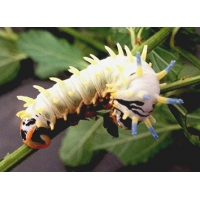
Epiphora mythimnia Africa
A fine African species, seldom obtained. The moth has deeply hooked wings and markings not unlike those of Atlas, but the colouring is a unique combination of burgundy, white and yellow, with clear triangular and circular eye-spots. mythimnia is one of the smaller species, and very beautiful.
The larvae have some characteristics in common with those of Attacus, whiteish, with fleshy tubercles.
Reported larval foodplants include evergreen Portuguese Laurel Prunus lusitanica, Ceanothus, Croton (colourful foliage house plant) and Alder Buckthorn Frangula alnus. It's probable that other food plants may be discovered. Evergreen Euphorbia characias (woolfeni) is a newly discovered foodplant.
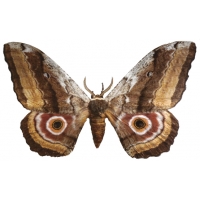
Gynansia maia Africa
A very spectacular Giant Silkmoth that we have only once offered before.
The larvae are most spectacular. Foodplants include Oak, Peach, Wattle Acacia and Legume trees such as Laburnum, False Acacia and Cassia. Evergreen possibilities are Evergreen Oaks, Portuguese Laurel Prunus lusitanica. It may be worth trying Eucalyptus.
Pupae are formed underground. The pupal period is usually more than a few weeks.

Antheraea yamamai Japan and Central Europe
A rewarding and easy species to rear in spring. The eggs are stored cool for the winter. Bring them into room temperature when the buds open, and the larvae hatch in a couple of weeks or so.
The caterpillar, a close relative of Antheraea pernyi, the Chinese Oak Silkmoth, grows very large. It has a green face and more interestingly, it spins a wonderful egg-shaped cocoon of BRIGHT GREEN silk. Very easy to rear on Oak. Also reported to feed on Beech Fagus, Sweet Chestnut Castanea, Hornbeam Carpinus, Rose, Hawthorn Crataegus, Sallow Salix caprea, Osier Salix viminalis. The pupa is spun in summer and does not emerge until well into autumn. Eggs laid in summer, are dormant through winter; they can be chilled, and hatch when the buds open in spring.
The female moth may be a bright canary yellow, with large ringed eye-spots, one in the centre of each wing. Colouring, especially in the male, is rather varied. Both sexes are illustrated with quite different colour forms.
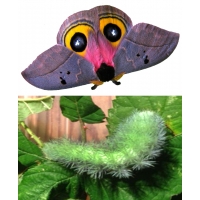
Automeris belti Mexico and Central America
An opportunity to rear something really NEW!
The first time offered by WWB. Seldom reared in captivity.
The moth is extremely beautiful. Even the underside is the most surprising vermilion red!
Larvae are gregarious until quite large. They are reported to feed on False Acacia Robinia, Oak Quercus, and Prunus particularly Cherry. Fig Ficus is also suggested, but Ficus is a widely differing Genus and they may not take to some.
As Automeris are very polyphagous, we expect the larvae to accept a wide variety of foodplants and suggest trying Salix Willows and Sallows for a start.

Tussore Silkmoth Antheraea mylitta India eggs
It is years since this species was last available. Don't miss these!
A very large silkmoth, one of India’s largest, noted for its great variety of colour forms and for the cocoon which is smooth and oval, a bit like a hen’s egg, and with a long silk stalk which the caterpillar spins to anchor the cocoon to the branch for the winter.
Click View to see the wonderful early stages of this magnificent silkmoth.
The larvae feed on Oak and Evergreen Oak (tender leaves). We have recently found they also feed on Rhus typhinus, whose leaves are still fresh late in the year. Also Apple, Liquidambar, Eucalyptus and probably other trees. They need warmth and humidity. Cleanliness is essential.
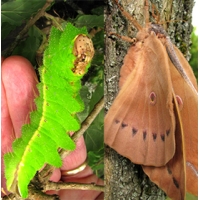
Chinese Silkmoth Antheraea pernyi
Highly recommended for those who are looking for a spectacular moth, with LARGE exotic larvae: easily reared.
This species used to be universally available. Over the years captive bred stocks have disappointingly become in-bred. We now have strong wild Chinese stock.
A large species, and undoubtedly the best for beginners. Moths emerge in the spring. They pair very easily.
Very easy to keep. Young larvae are black, and later turn green. They become enormous, feeding on Oak, Birch, Sweet Chestnut, Horse Chestnut, Prunus, Hornbeam (Carpinus), Apple, Hawthorn, Beech, Osier Willow. After about 2 months the larvae spin silk cocoons - an extra opportunity for a teaching project. Moths emerge the same year. Autumn larvae spin over-wintering cocoons.
Larvae thrive on Evergreen Oak when other plants not available. In winter, if the evergreen leaves are a bit leathery, make some incisions in the leaves with scissors. This releases attractive scent to the larvae and and gives them easier places to start feeding.
A PERFECT species for children and beginners!

Bullseye Moth Automeris io North America
Eggs and Larvae of the Bullseye Moth are not available every year. This small silkmoth has a number of interesting characteristics.
The male and female are distinctly different colours – both have the enormous eye markings on the hindwings which are exposed when the moth is disturbed.
The larvae are covered by branched spines – don’t touch them – they sting like a nettle! They are gregarious until the larvae are quite large, changing colour at each skin change.
For pairing, keep the moths in a cage the size of the Pyjama Mini Cage. Fertile eggs develop a black dot which is the micropyle, through which the embryo breathes. A useful indicator of fertility, not present in most other species.
The larvae are polyphagous, ie they will accept a wide variety of foodplants, which include such trees as Oak, Lime, Willow, Hazel, Bramble, Apple, Hawthorn and more.
Automeris excreta from Guatemala
In captivity the larvae have accepted Privet Ligustrum vulgare, Bramble Rubus, and Sallow Salix caprea. As with other Automeris species, the larvae are gregarious, and they are covered with branched, Christmas tree-like spines, which sting, so don't handle them.
This is an opportunity to breed a really unusual species!

European Cynthia Moth Philosamia cynthia from Italy
This species has now become scarce in Europe and we may not get regular supplies in future.
Very easy to rear on Privet, Willows, Ailanthus, Llilac and other shrubs, including evergreens, such as Portugal Laurel, Viburnum tinus and Acuba.
The moths pair easily. The young larvae are yellow, decorated with black spots, and live gregariously. As they grow they become pure white, with prominent black spots. In the final instar they have a white waxy bloom.
Highly recommended.
European Cynthia Moth Philosamia cynthia from Italy
This species has now become scarce in Europe and we may not get regular supplies in future.
Very easy to rear on Privet, Willows, Ailanthus, Llilac and other shrubs, including evergreens, such as Portugal Laurel, Viburnum tinus and Acuba.
The moths pair easily. The young larvae are yellow, decorated with black spots, and live gregariously. As they grow they become pure white, with prominent black spots. In the final instar they have a white waxy bloom.
Highly recommended.