
Current EGGS and LARVAE
If you are a beginner and need information on rearing from small caterpillars, or hatching out pupae, please order the All Colour Paperback BUTTERFLIES. INSTRUCTIONS ARE NOT SENT WITH EACH SPECIES, you need to acquire basic skills and this book is a simple way of doing so.
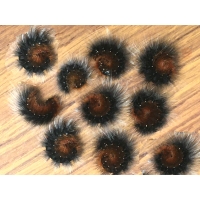
Garden Tiger Moth Arctia caja
Young larvae that in the wild would hibernate and if kept warm and active, could develop and produce another generation this year. If young larvae are released into hedgerows, there is the opportunity to introduce Woolly Bears back into the countryside, where once they were abundant each spring.
Garden Tiger larvae Woolly Bears grow fast on Dock, Dandelion, Dead Nettle, Nettle and many other hedgerow plants, also Pussy Willow Salix caprea and Osier Willow Salix viminalis. You can also feed them conveniently on Cabbage.
Now a most difficult species to obtain.
In the wild, late summer larvae would hibernate, but if you keep them warm and light, many will produce another generation this year.
If you wish to hibernate Wooly Bears, sleeve them in autumn on Willow or Sallow (Pussy Willow). The falling leaves curl to form a ventilated ball in which the larvae hibernate. If all goes well in winter the larvae emerge in spring and feed from the new spring leaves.
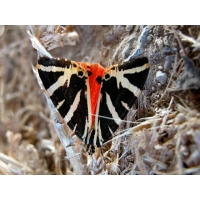
Jersey Tiger Moth Euplagia quadripunctaria
A very active and exotic European tiger moth, which occurs in a very small area of the south-west of Britain, the Torbay area, as well as in Europe.
The larvae feed on Hemp Agrimony, Dandelion, Forgetmenot, Dock, Nettle, Dead Nettle, Plantain, Bramble and other low-growing plants. The larvae, as with other Tigers, have prominent tufts of hair, and colourful markings. The hairs may give a rash on handling, but seldom do. Pupae are formed in leaf litter.
Hibernating is achieved well on potted foodplant protected from predators by a fine net enclosing pot and plant. In spring the larvae begin to feed again and produce moths in summer.
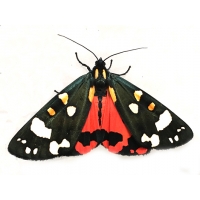
Scarlet Tiger Panaxia dominula
We suggest keeping newly-hatched larvae in a soft paper-lined size 7 plastic box on a fresh leaf of Sallow or Plum. The larvae quickly perforate the leaf which must be changed daily. When changing the leaf, the larvae readily drop off and curl up, before scattering, which gives the opportunity to make the change. But be quick! As the larvae grow they can be moved to a larger plastic box, for further growth before sleeving either on a potted foodplant (enclose the pot and plant). Hibernation in captivity may be done in several ways, but we now suggest hibernating them sleeved, pot and all, in a large pot of Comfrey, which should be kept out of doors in all weathers, and able to drain. In nature eggs are scattered loose amongst the foliage that the larvae like to feed on. The young larvae feed and grow for some weeks before hibernating deep in the base of ground foliage. In spring they resume feeding - their spectacular yellow and black patterning making a striking site on green foliage.
The larvae feed on Dead Nettle, Stinging Nettle, Willow, Sallow, Bramble, Sloe and Plum. They especially like Comfrey and Borage. They often browse on other hedgerow plants. Whilst, in the wild, these larvae would hibernate, if you keep them warm and well-fed, in captivity a second brood may be possible.
Pupation is amongst litter at the base of the foodplant and the magnificent day-flying moths emerge in June. Pairing is easy. Eggs are laid loose in the herbage and the tiny larvae feed for a while before hibernation at the base of the foodplant.
Hibernation in captivity can be achieved by sleeving the young larvae on a branch of Salix, Willow or Sallow, Sloe or Plum. The accumulation of autumn leaves makes an ideal environment for the hibernating larvae which re-appear when the buds begin to open in March. In nature eggs are scattered loose amongst the foliage that the larvae like to feed on. The young larvae feed and grow for some weeks before hibernating deep in the base of ground foliage. In spring they resume feeding - their spectacular yellow and black patterning making a striking site on green foliage.
Scarlet Tigers fly by day - a wonderful sight on a sunny June day. In spring the colourful caterpillars are a joy to rear and very easy on potted foodplant.
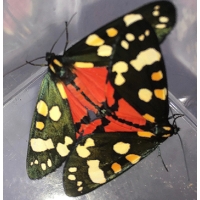
Scarlet Tiger Panaxia dominula
BREEDING HAS BEEN MOST SUCCESSFUL this summer. There is a special price for 100 eggs.
We suggest keeping newly-hatched larvae in a soft paper-lined size 7 plastic box on a fresh leaf of Sallow or Plum. These leaves are suggested because of their keeping qualities. The larvae quickly perforate the leaf which must be changed daily. When changing the leaf, the larvae readily drop off and curl up, before scattering, which gives the opportunity to make the change. But be quick! As the larvae grow they can be moved to a larger plastic box, for further growth before sleeving either on a potted foodplant (enclose the pot and plant), or on a branch of Plum or Sallow Salix caprea.
The larvae feed on Dead Nettle, Stinging Nettle, Willow, Sallow, Bramble, Sloe and Plum. They especially like Comfrey and Borage. They often browse on other hedgerow plants. Whilst, in the wild, these larvae would hibernate, if you keep them warm and well-fed, in captivity a second brood may be possible.
Pupation is amongst litter at the base of the foodplant and the magnificent day-flying moths emerge in June. Pairing is easy. Eggs are laid loose in the herbage and the tiny larvae feed for a while before hibernation at the base of the foodplant.
Hibernation in captivity can be achieved by sleeving the young larvae on a branch of Salix, Willow or Sallow, Sloe or Plum. The accumulation of autumn leaves makes an ideal environment for the hibernating larvae which re-appear when the buds begin to open in March. In nature eggs are scattered loose amongst the foliage that the larvae like to feed on. The young larvae feed and grow for some weeks before hibernating deep in the base of ground foliage. In spring they resume feeding - their spectacular yellow and black patterning making a striking site on green foliage.
Scarlet Tigers fly by day - a wonderful sight on a sunny June day. In spring the colourful caterpillars are a joy to rear and very easy on potted foodplant.
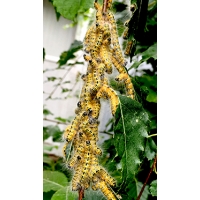
Buff Tip Moth Phalera bucephala
The Buff Tip, once very common, is remarkable and a must for the enthusiast. You could help re-establish Buff Tips in your area. The eggs are laid in a tight cluster on a leaf of the foodplant. A hatched group of eggs is illustrated and you can see the skeletonised leaf left by the tiny larvae as they progress feeding across the leaf. The larvae are gregarious and quite conspicuous by the trail of eaten leaves, and the fact that they form quite a lumpy cluster!
They are coloured with a netted pattern of yellow and black, warning colours that ward off predators, and larger larvae have a covering of long, fine white silky hairs. The group does not disperse until pupation when they descend to burrow quite deep into the soil.
The moth is a master of deception, rolling its wings to form a silvery tube with extraordinary likeness at either end to a broken branch. If it flies up on being disturbed, it is hard to spot on landing, unless you know what you are looking for, because it so closely resembles a piece of branch. The larvae feed Maple, Birch, Hazel, Laburnham, Poplar, Prunus (Plums and Blackthorn), Oak, False Acacia Robinia, Hazel, Rose, Willows, Sallows, Lime, Elm, Viburnums.
We recommend Buff Tips as a great experience of nature.
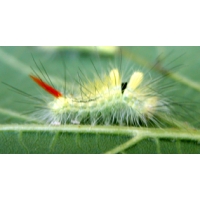
Pale Tussock Moth Dasychira pudibunda
The larvae are tufted with the most delightful coloured shaving brushes, with jet black between the segments, which the larva exposes when threatened. There are different larval colour forms.
Foodplants are many and include Lime, Hazel, Oak, Willow, Poplar, Birch and others.
Cocoons are spun in late summer and the moths emerge in the following spring.
Once known as the Hop Dog, the larvae were encountered in the Hop fields when south Londeners migrated in thousands to Kent to gather the season’s crop.

The Belted Beauty Lycia zonaria
Eggs and larvae have never been offered before. Emerald green eggs are laid in large egg batches. A whole batch of not less than 50 eggs is amazing value, and provides enough larvae to experiment with different foodplants and rearing methods. We advocate using growing foodplant when possible, and sleeving the whole pot of food.
In Britain this species is very rare indeed, and protected. Found in only about 3 localities on sandy nutrient-poor grassland or dunes. Very scarce in Holland, where it occurs in similar coastal areas. Our stock comes from central Europe, where it is sometimes found on dry limestone slopes where the vegetation is sparse.
The larvae feed on a variety of plants and you may be amongst those who discover new foodplants.
Eggs are laid in batches particularly on grasses where they can be tucked into pockets and hollow stems. The larvae feed on a variety of vegetation - possibly almost anything that is growing amongst the grasses. They appear to like a variety of foodplants and are recorded as feeding on Dandelion, Dock, Cow Parsley, Clovers, Kidney Vetch, Bird’s-foot Trefoil, Yarrow, Creeping Willows and Sallows, Hawthorn, Coltsfoot, Plantains, Burnet Rose and even Flag Iris. The larva, starting black with prominent white spots, becomes medium green, well camouflaged colour, but with a prominent lemon yellow lateral stripe. This is a Geometer - looper caterpillar.
This is one of the few moths that has a wingless female. The female rests sometimes prominently where they more easily attract males, which fly by day and by night.
The pupa is formed only a little below the ground surface, where it spends the winter. Store winter pupae in a closed plastic box, very cool or refrigerated. To avoid desiccation don't leave in open air. In the emerging cage, keep moist at all times. See the Pupae Nest on this website. Emergence starts in the very early spring.
This is an opportunity not to be missed, to breed a very rare species and see its life history at first hand.

Vapourer Moth Orgyia antiqua
Eggs are laid by the wingless female in a batch on the cocoon, where they pass the winter and hatch in spring.
Very interesting both for its moth and its very attractive and colourful caterpillar. Winter eggs are supplied for storage in the cool until spring. The larvae normally hatch in May/June or later, and feed on a wide variety of trees, which include Hawthorn, Willows and Sallows, most fruit trees, Hazel, Rose, Lime and Oak. The larvae are beautifully patterned and coloured, and decorated by prominent shaving brush-like tufts. The cocoon is spun amongst the foodplant.
The male moth is delicate, chestnut brown, with prominent feathered antennae, which are used to detect the wingless female, who emerges from the cocoon and rests on it, calling for a male. She lays her egg batch all over the cocoon where the eggs remain through the winter ready to start off the next generation.
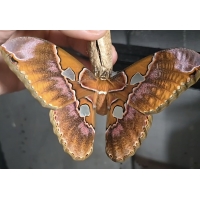
Rothschildia equatoralis Central America
The parent moths are nearly the size of Atlas moths! Eggs immediately available, sent to you direct from our European breeder.
The larvae develop quickly on Privet in a temperature of 25º. Give large larvae plenty of food and space.
Resulting cocoons will produce moths this summer and will give further generations this year.
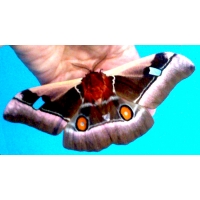
Cabbage Emperor Bunaea alcinoe Africa
The larvae thrive on Privet and become most spectacular. Ivy has also been found to be a possible winter foodplant. Deciduous foodplants include Hawthorn, Cherry, Apple, Plum, Willows and Oaks. Evergreen foodplants recorded include Evergreen Oaks, Portugurese Laurel Prunus lusitanica. Undoubtedly other trees would be accepted.
Larvae pupate underground.
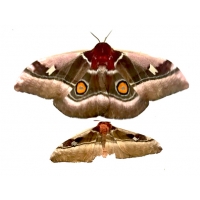
Cabbage Emperor Bunaea alcinoe 'TITAN' Africa
THIS IS A NEW GIANT RACE, NEVER LISTED BEFORE. EGGS AVAILABLE IMMEDIATELY!
ALL FOUR STAGES ARE ABOUT ONE THIRD LARGER THAN THE TYPICAL. We are told that this breeds through

The larvae thrive on Privet and become most spectacular. Ivy has also been found to be a possible winter foodplant. Deciduous foodplants include Hawthorn, Cherry, Apple, Plum, Willows and Oaks. Evergreen foodplants recorded include Evergreen Oaks, Portugurese Laurel Prunus lusitanica. Undoubtedly other trees would be accepted.
Larvae pupate underground.
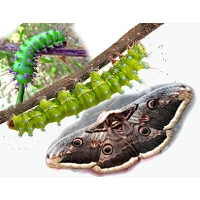
Giant Peacock Moth Saturnia pyri
Europe's largest Moth! Larvae sleeved outside do well except in constant wet and cold weather. The large larva, with its apple green colouring and colourful spikey tubercles, is as handsome as the tropical Moon Moths.
The natural foodplants are Blackthorn and Hawthorn but they will often accept fruit trees such a Plum and Apple. Cocoons spun in summer produce moths in the following spring.