
SPRING and SUMMER EGGS and LARVAE Order now for supply in season

American Moon Moth Actias luna North America
A very attractive Moon Moth that is double brooded and is very easy to rear. Larvae of the first brood produce moths this year.
The larvae feed on Walnut, and have been recorded as accepting Liquidambar, Birch, Plane, Maples, Aspen, Plum, Sallow, Osier Willow and several kinds of Oak. We have excellent results with Walnut and Osier.
Store autumn cocoons cool, even in a fridge from December onwards. In April they can be incubated for emergence in May/June.

Madagascan Moon Moth Argema mittrei
10 Eggs normally £25.95 now £19.95 LIMITED TIME OFFER!
20 Eggs normally £51.90 now £29.95
Eggs of this huge Moon Moth are the largest we have ever seen. See the photo of one compared to other Giant Silkmoth eggs!
Eggs are sent direct from our breeder in Holland.
The larvae like warmth but not excessive temperature: likewise humidity but not too much. They feed well on Liquidambar, Eucalyptus gunii, Rhus typhina and Rhus glabra.
Huge netted cocoons of silvery silk – probably the biggest cocoon in the world! Both male and female moths are tailed but those of the male are very extreme.
This is a species that the connoisseur should not miss!
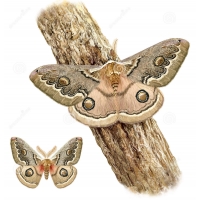
Saturnia (Neoris) schencki Kazakhstan
This is a large silkmoth occurring in Kazakhstan, recorded as a separate species from Neoris huttoni that is normally offered. It is very seldom available and never offered before by WWB! These cocoons are produced from the race in the Almaty region, Altyn Emel, Kazakhstan, altitude 800 meters.
The cocoons will produce moths in late summer or autumn, and lay eggs that overwinter. Only a limited supply available.
Read more about this species in the article by the Saturniid specialists Nässig, Naumann and Löffler by following the link at the bottom of this text.
We have never had this species before. Larvae illustrations are of N. huttoni. as we have never reared schencki whose larvae are reported to look much the same.
The hibernating eggs are simply stored in the refrigerator until buds open in spring.
The larvae like Ash Fraxinus in particular, Pear Pyrus, Plum and probably Cherry Prunus (Prunus padus is particularly successful), Willows Salix, Privet Ligustrum, Stag’s Horn Sumac Rhus thypina, Spirea. [We have had a report of larvae not taking to Privet but we have reared Huttoni on Privet]
The larvae live beneath a leaf and do not like being disturbed. Young larvae go through interesting and different colour forms.
The cocoon is formed in litter on the ground. Moths emerge in autumn and lay overwintering eggs.
Our thanks to Dr. A. Pittaway for kindly letting us show some of his pictures.
See the article by the Saturniid specialists Nässig, Naumann and Löffler by following this link:
https://www.researchgate.net/publication/344163414_Revisional_notes_on_the_subgenera_Saturnia_Perisomena_and_Saturnia_Neoris_stat_rev_Lepidoptera_Saturniidae_-_Part_B_Neoris_with_a_homonymy_correction_note

Antheraea yamamai Japan and Central Europe
A rewarding and easy species to rear in spring. The eggs are stored cool for the winter. Bring them into room temperature when the buds open, and the larvae hatch in a couple of weeks or so.
The caterpillar, a close relative of Antheraea pernyi, the Chinese Oak Silkmoth, grows very large. It has a green face and more interestingly, it spins a wonderful egg-shaped cocoon of BRIGHT GREEN silk. Very easy to rear on Oak. Also reported to feed on Beech Fagus, Sweet Chestnut Castanea, Hornbeam Carpinus, Rose, Hawthorn Crataegus, Sallow Salix caprea, Osier Salix viminalis. The pupa is spun in summer and does not emerge until well into autumn. Eggs laid in summer, are dormant through winter; they can be chilled, and hatch when the buds open in spring.
The female moth may be a bright canary yellow, with large ringed eye-spots, one in the centre of each wing. Colouring, especially in the male, is rather varied. Both sexes are illustrated with quite different colour forms.

Tussore Silkmoth Antheraea mylitta India eggs
It is years since this species was last available. Don't miss these!
A very large silkmoth, one of India’s largest, noted for its great variety of colour forms and for the cocoon which is smooth and oval, a bit like a hen’s egg, and with a long silk stalk which the caterpillar spins to anchor the cocoon to the branch for the winter.
Click View to see the wonderful early stages of this magnificent silkmoth.
The larvae feed on Oak and Evergreen Oak (tender leaves). We have recently found they also feed on Rhus typhinus, whose leaves are still fresh late in the year. Also Apple, Liquidambar, Eucalyptus and probably other trees. They need warmth and humidity. Cleanliness is essential.
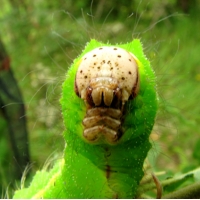
Chinese Silkmoth Antheraea pernyi
Highly recommended for those who are looking for a spectacular moth, with LARGE exotic larvae: easily reared.
This species used to be universally available. Over the years captive bred stocks have disappointingly become in-bred. We now have strong wild Chinese stock. s
A large species, and undoubtedly the best for beginners. Moths emerge in the spring. They pair very easily.
Very easy to keep. Young larvae are black, and later turn green. They become enormous, feeding on Oak, Birch, Sweet Chestnut, Horse Chestnut, Prunus, Hornbeam (Carpinus), Apple, Hawthorn, Beech, Osier Willow. After about 2 months the larvae spin silk cocoons - an extra opportunity for a teaching project. Moths emerge the same year. Autumn larvae spin over-wintering cocoons.
Larvae thrive on Evergreen Oak when other plants not available. In winter, if the evergreen leaves are a bit leathery, make some incisions in the leaves with scissors. This releases attractive scent to the larvae and and gives them easier places to start feeding.
A PERFECT species for children and beginners!
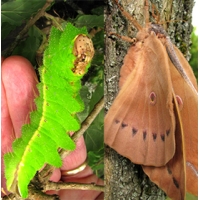
Chinese Silkmoth Antheraea pernyi
Highly recommended for those who are looking for a spectacular moth, with LARGE exotic larvae: easily reared.
This species used to be universally available. Over the years captive bred stocks have disappointingly become in-bred. We now have strong wild Chinese stock.
A large species, and undoubtedly the best for beginners. Moths emerge in the spring. They pair very easily.
Very easy to keep. Young larvae are black, and later turn green. They become enormous, feeding on Oak, Birch, Sweet Chestnut, Horse Chestnut, Prunus, Hornbeam (Carpinus), Apple, Hawthorn, Beech, Osier Willow. After about 2 months the larvae spin silk cocoons - an extra opportunity for a teaching project. Moths emerge the same year. Autumn larvae spin over-wintering cocoons.
Larvae thrive on Evergreen Oak when other plants not available. In winter, if the evergreen leaves are a bit leathery, make some incisions in the leaves with scissors. This releases attractive scent to the larvae and and gives them easier places to start feeding.
A PERFECT species for children and beginners!

Bullseye Moth Automeris io North America
Eggs and Larvae of the Bullseye Moth are not available every year. This small silkmoth has a number of interesting characteristics.
The male and female are distinctly different colours – both have the enormous eye markings on the hindwings which are exposed when the moth is disturbed.
The larvae are covered by branched spines – don’t touch them – they sting like a nettle! They are gregarious until the larvae are quite large, changing colour at each skin change.
For pairing, keep the moths in a cage the size of the Pyjama Mini Cage. Fertile eggs develop a black dot which is the micropyle, through which the embryo breathes. A useful indicator of fertility, not present in most other species.
The larvae are polyphagous, ie they will accept a wide variety of foodplants, which include such trees as Oak, Lime, Willow, Hazel, Bramble, Apple, Hawthorn and more.

European Cynthia Moth Philosamia cynthia from Italy
This species has now become scarce in Europe and we may not get regular supplies in future.
Very easy to rear on Privet, Willows, Ailanthus, Llilac and other shrubs, including evergreens, such as Portugal Laurel, Viburnum tinus and Acuba.
The moths pair easily. The young larvae are yellow, decorated with black spots, and live gregariously. As they grow they become pure white, with prominent black spots. In the final instar they have a white waxy bloom.
Highly recommended.
European Cynthia Moth Philosamia cynthia from Italy
This species has now become scarce in Europe and we may not get regular supplies in future.
Very easy to rear on Privet, Willows, Ailanthus, Llilac and other shrubs, including evergreens, such as Portugal Laurel, Viburnum tinus and Acuba.
The moths pair easily. The young larvae are yellow, decorated with black spots, and live gregariously. As they grow they become pure white, with prominent black spots. In the final instar they have a white waxy bloom.
Highly recommended.

Eri Silkmoth Philosamia cynthia ricini
A very attractive form with dark banded moths. Very easy indeed to breed in captivity.
The larvae feed on Privet, and are very easy to rear in all seasons. Other evergreen foodplants accepted include Portuguese Laurel Prunus lusitanica, which they relish, Rhododendron, Laurel, and Golden-spotted Laurel Acuba.
Deciduous foodplants: Tree of Heaven Ailanthus is quite their favourite food. They also thrive on Willows, especially Osier Salix viminalis, Cherry, Laburnham, Lilac, Rose, Plum, Apple, Ash, Birch, Elder and doubtless many more.
The larvae are gregarious when young, yellow and black. Larger larvae are covered with white waxy powder. This subspecies is continuously brooded and can be kept going in all seasons. The cocoon is white and can be used to produce spun silk.
-200x200.jpg "Forbes’ Atlas Moth Rothschildia forbesi (R. lebeau). Central America 15 eggs")
Forbes’ Atlas Moth Rothschildia forbesi (R. lebeau).
The Rothschildia species occur in the New World only. They are attractive in all stages and easy to rear.
The larvae of forbesi (also known as lebeau) change from striped yellow and black to green, with a strong lateral line separating the underside which is paler green and downy. They are easy to rear on Privet and fast growing in warmer temperatures.