
SPRING and SUMMER EGGS and LARVAE Order now for supply in season
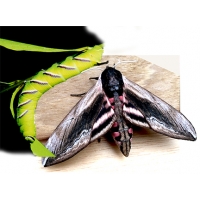
Privet Hawkmoth Sphinx ligustri
A real favourite! These are quite one of Britain’s largest and grandest caterpillars.
Start young larvae in plastic boxes (see advice under Plastic Rearing Containers on this site). Later they can be sleeved if the weather is warm and not too wet. Alternatively cage the larvae on cut food in water (stuff the mouth of the jar to prevent drowning), or you can use a sleeve in place of a cage.
The caterpillar becomes enormous and is characteristic of the name Sphinx moths, by its sphinx-like resting position. When ready to pupate, the larvae become a bruised apple brown colour and start to wander. At this stage, collect them and put in a plastic tub with about 100 cm of soil or compost in the bottom, and some leaf litter on top. The larvae burrow and pupate in the compost. Leave for two weeks to harden, then carefully bring them to the surface and store them in a plastic box for the winter. From late December keep them refrigerated until May, when they can be put in the emerging cage. Please read the way of keeping underground pupae in the emerging cage, as outlined under Pupae Nest on this website.
Adults emerge in June and July. They need nectar from the flowers of Privet, Valerian, Buddleia.
Larval foodplants: Privet, Lilac, Ash, also reportedly Spiraea, Viburnum opulus, and other Viburnums, Holly, Dogwood, Snowberry, Apple, Pear, Oleander, Leycesteria, Currant.
One generation in the year. Privet Hawks breed readily in a large cage with nectar and foodplant.
The large pupae are formed underground. Store the pupae cold for emergence next summer.
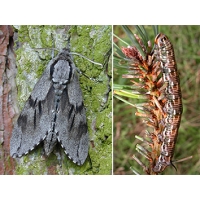
Pine Hawk Hyloicus pinastri
Extremely easy to rear on Pine. The larvae change colour and pattern as they shed their skins and grow, each new attire demonstrating remarkable camouflage. They do best sleeved on growing pine but can also be reared on cut food as long as well cared for and hygienic conditions maintained. The larvae pupate in the soil. Store pupae refrigerated until next summer.
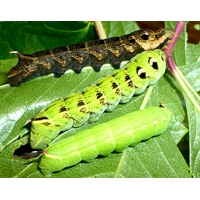
Elephant Hawk Dielephila elpenor
A most attractive and easy species to rear. The larvae feed on Willowherbs, Fuschia, Virginia Creeper, Vine and Bedstraw. Fast-growing, the larvae have two colour forms, starting green they change to black, or a lovely green form, the green being the rarest.
The larvae pupate amongst leaf litter on the ground, and emerge next spring as one of the most beautiful of all hawkmoths.
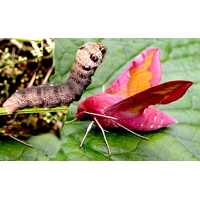
Small Elephant Hawk Dielephila porcellus
Very seldom can we offer eggs and larvae of this brilliantly coloured and delicate little Hawkmoth. The larvae are miniatures of the Elephant Hawk.
The best foodplant is Bedstraw Galium, any species. Other foodplants are recorded as possible alternatives: Willowherb, Purple Loosestrife, Impatiens (Balsam and perhaps Busy Lizzie), Vine and Parthenocissus. Don’t miss this opportunity of rearing the Small Elephant Hawk this year.

Kentish Glory Endromis versicolora
The larvae, black at first, cluster on the twigs. Later they are green and spread out a little, clinging on to the twigs, they look just like Birch catkins. Absolute masters of camouflage. Birch is the normal foodplant, but the larvae can also be reared on Hazel, Alder, Hornbeam, and Lime.
This species is now found only in Scotland, and parts of Central Europe. Our stock is European.
Rearing of Kentish Glory larvae is very easy, indoors or outside, and they do particularly well sleeved on their foodplant. In May/June the larvae pupate in leaf litter and soil and settle down until the new season starts again in February. This is a very easy species.
The male and female moths share the same patterning, but the female is much larger and the male has particularly rich chestnut markings. Pairing is easy. Provide twigs of foodplant, on which to lay. At this time there are no leaves. Just leave the moths together pairing and egg-laying take place naturally.The Eggs are the first of the season to be laid in February and March. They are yellow when laid, later turning maroon in colour, matching the twigs they are laid on. Keep the eggs cool until you have the first leaves of foodplant.
Our thanks to Jens Stolt who has kindly allowed us to use his beautiful illustration of the life history of this rare species.

Oleander Hawk Daphnis nerii
Because the egg stage is only a few days, they cannot be supplied outside Britain.
One of the finest of all Hawkmoths. The larvae are very fast growing indeed and they consume a lot of food. It is often possible to have the larvae from hatching to pupation in little more than a month.
Larvae thrive on Privet and can be reared on Periwinkle Vinca, or Honeysuckle Lonicera. Suitable for winter or summer rearing. Oleander Nerium is a natural foodplant but it is often tough and leathery, so the alternives are usually better than Oleander.
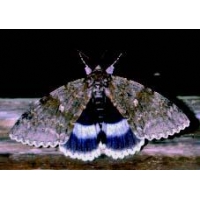
Clifden Nonpareil (Blue Underwing) Catocala fraxini
The largest underwing, spectacular blue. Store eggs refrigerated until May.
This species is now almost extinct in Britain. We are offering European stock of this fine moth, the largest of all Underwings and remarkable for its BLUE hindwings. The young larvae are immensely active and care must be taken when transferring them to fooplant on hatching, because they can tangle themselves up if you try to move more than one at a time! Feed on Aspen and other Poplars. The larvae are the largest of this genus and very satisfying to rear. Moths emerge in late summer, laying eggs that overwinter.
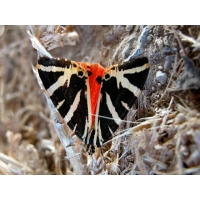
Jersey Tiger Moth Euplagia quadripunctaria
A very active and exotic European tiger moth, which occurs in a very small area of the south-west of Britain, the Torbay area, as well as in Europe.
The larvae feed on Hemp Agrimony, Dandelion, Forgetmenot, Dock, Nettle, Dead Nettle, Plantain, Bramble and other low-growing plants. The larvae, as with other Tigers, have prominent tufts of hair, and colourful markings. The hairs may give a rash on handling, but seldom do. Pupae are formed in leaf litter.
Hibernating is achieved well on potted foodplant protected from predators by a fine net enclosing pot and plant. In spring the larvae begin to feed again and produce moths in summer.

Cinnabar Moth Hipocrita jacobaeae
Once an extremely common British Moth, less common over most of Europe, but over the last 10 years there has been a marked decline in numbers. The summer of 2016 brought a reversal of this decline and we can help this species back from danger of disappearing.
The larvae feed on Groundsel and Ragwort Senecio. The larvae are ringed in bright orange and black, nature's warning colours, and they absorb chemicals from the foodplant that adversely affect predators who ignore the warning. Ragwort is a mis-understood plant that provides an abundance of nectar to bees, butterflies and other insects. There is evidence that Ragwort plants that are pulled up and left to dry, can be detrimental to cattle and horses if they eat the dried plants. Animals can be seen grazing safely in fields containing growing green plants. There is nothing to be gained from pulling up Ragwort plants, because they are biennials that flower and die in the same year. So a patch of Ragwort can provide valuable nectar to thousands of wild insects, and be host to Cinnabar larvae and, job completed, it dies at the end of summer.
The Cinnabar moth flies by day, more than by night, and is protected from predators, by the very striking colours of charcoal and scarlet, and bitter-tasting chemicals derived from the larval foodplant, enabling the moth to display its bright colours, yet not be attacked by predators.
Cinnabar larvae can be raised in sleeves on growing Ragwort. We find the sleeves fitted with a zip are particularly successful. When the larvae are large, if you put in the sleeve several handfuls of springy wood shavings or dried leaf litter, they will form thin silken cocoons in which to pupate.
Could you help to spread this colourful day-flying moth again in your area?
Store pupae cool for the winter, even in a fridge, loose in a plastic box, without any padding. In May lay them out in an emerging cage and wait for the moths to emerge.
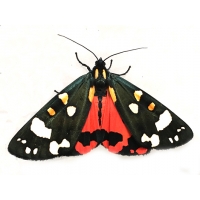
Scarlet Tiger Panaxia dominula
We suggest keeping newly-hatched larvae in a soft paper-lined size 7 plastic box on a fresh leaf of Sallow or Plum. The larvae quickly perforate the leaf which must be changed daily. When changing the leaf, the larvae readily drop off and curl up, before scattering, which gives the opportunity to make the change. But be quick! As the larvae grow they can be moved to a larger plastic box, for further growth before sleeving either on a potted foodplant (enclose the pot and plant). Hibernation in captivity may be done in several ways, but we now suggest hibernating them sleeved, pot and all, in a large pot of Comfrey, which should be kept out of doors in all weathers, and able to drain. In nature eggs are scattered loose amongst the foliage that the larvae like to feed on. The young larvae feed and grow for some weeks before hibernating deep in the base of ground foliage. In spring they resume feeding - their spectacular yellow and black patterning making a striking site on green foliage.
The larvae feed on Dead Nettle, Stinging Nettle, Willow, Sallow, Bramble, Sloe and Plum. They especially like Comfrey and Borage. They often browse on other hedgerow plants. Whilst, in the wild, these larvae would hibernate, if you keep them warm and well-fed, in captivity a second brood may be possible.
Pupation is amongst litter at the base of the foodplant and the magnificent day-flying moths emerge in June. Pairing is easy. Eggs are laid loose in the herbage and the tiny larvae feed for a while before hibernation at the base of the foodplant.
Hibernation in captivity can be achieved by sleeving the young larvae on a branch of Salix, Willow or Sallow, Sloe or Plum. The accumulation of autumn leaves makes an ideal environment for the hibernating larvae which re-appear when the buds begin to open in March. In nature eggs are scattered loose amongst the foliage that the larvae like to feed on. The young larvae feed and grow for some weeks before hibernating deep in the base of ground foliage. In spring they resume feeding - their spectacular yellow and black patterning making a striking site on green foliage.
Scarlet Tigers fly by day - a wonderful sight on a sunny June day. In spring the colourful caterpillars are a joy to rear and very easy on potted foodplant.
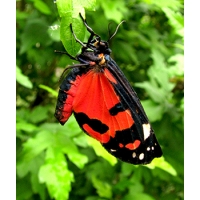
Scarlet Tiger Panaxia dominula
We suggest keeping newly-hatched larvae in a soft paper-lined size 7 plastic box on a fresh leaf of Sallow or Plum. These leaves are suggested because of their keeping qualities. The larvae quickly perforate the leaf which must be changed daily. When changing the leaf, the larvae readily drop off and curl up, before scattering, which gives the opportunity to make the change. But be quick! As the larvae grow they can be moved to a larger plastic box, for further growth before sleeving either on a potted foodplant (enclose the pot and plant), or on a branch of Plum or Sallow Salix caprea.
The larvae feed on Dead Nettle, Stinging Nettle, Willow, Sallow, Bramble, Sloe and Plum. They especially like Comfrey and Borage. They often browse on other hedgerow plants. Whilst, in the wild, these larvae would hibernate, if you keep them warm and well-fed, in captivity a second brood may be possible.
Pupation is amongst litter at the base of the foodplant and the magnificent day-flying moths emerge in June. Pairing is easy. Eggs are laid loose in the herbage and the tiny larvae feed for a while before hibernation at the base of the foodplant.
Hibernation in captivity may be done in several ways, but we now suggest hibernating them sleeved, pot and all, in a large pot of Comfrey, which should be kept out of doors in all weathers, and able to drain. In nature eggs are scattered loose amongst the foliage that the larvae like to feed on. The young larvae feed and grow for some weeks before hibernating deep in the base of ground foliage. In spring they resume feeding - their spectacular yellow and black patterning making a striking site on green foliage.
Scarlet Tigers fly by day - a wonderful sight on a sunny June day. In spring the colourful caterpillars are a joy to rear and very easy on potted foodplant.
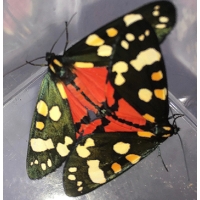
Scarlet Tiger Panaxia dominula
BREEDING HAS BEEN MOST SUCCESSFUL this summer. There is a special price for 100 eggs.
We suggest keeping newly-hatched larvae in a soft paper-lined size 7 plastic box on a fresh leaf of Sallow or Plum. These leaves are suggested because of their keeping qualities. The larvae quickly perforate the leaf which must be changed daily. When changing the leaf, the larvae readily drop off and curl up, before scattering, which gives the opportunity to make the change. But be quick! As the larvae grow they can be moved to a larger plastic box, for further growth before sleeving either on a potted foodplant (enclose the pot and plant), or on a branch of Plum or Sallow Salix caprea.
The larvae feed on Dead Nettle, Stinging Nettle, Willow, Sallow, Bramble, Sloe and Plum. They especially like Comfrey and Borage. They often browse on other hedgerow plants. Whilst, in the wild, these larvae would hibernate, if you keep them warm and well-fed, in captivity a second brood may be possible.
Pupation is amongst litter at the base of the foodplant and the magnificent day-flying moths emerge in June. Pairing is easy. Eggs are laid loose in the herbage and the tiny larvae feed for a while before hibernation at the base of the foodplant.
Hibernation in captivity can be achieved by sleeving the young larvae on a branch of Salix, Willow or Sallow, Sloe or Plum. The accumulation of autumn leaves makes an ideal environment for the hibernating larvae which re-appear when the buds begin to open in March. In nature eggs are scattered loose amongst the foliage that the larvae like to feed on. The young larvae feed and grow for some weeks before hibernating deep in the base of ground foliage. In spring they resume feeding - their spectacular yellow and black patterning making a striking site on green foliage.
Scarlet Tigers fly by day - a wonderful sight on a sunny June day. In spring the colourful caterpillars are a joy to rear and very easy on potted foodplant.