
SPRING and SUMMER EGGS and LARVAE Order now for supply in season
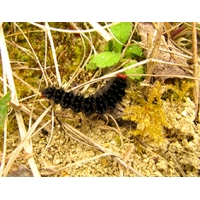
Glanville Fritillary Melitaea cinxia
EGG MASS, never offered before, is best attached to a large and healthy potted foodplant where the larvae can hatch, live in a web and eventually hibernate. We advise keeping the pot caged or sleeved, for protection from predators. An egg mass will produce dozens of larvae.
Feed on Narrow-leaved Plantain. Easiest to keep on potted foodplant, enclosed in a sleeve. The larvae are gregarious, living in a tight bunch at the base of the plant, and spreading out more as they grow larger. The ginger head capsule and jet black body distinguish these larvae from other species.
In Britain this species lives mainly on the Isle of Wight coast, but they have been established elsewhere in Britain. Maybe they could be encouraged in more localities.
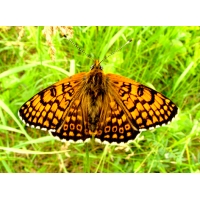
Glanville Fritillary Melitaea cinxia
Feed on Narrow-leaved Plantain. Easiest to keep on potted foodplant, enclosed in a sleeve. The larvae are gregarious, living in a tight bunch at the base of the plant, and spreading out more as they grow larger. The ginger head capsule and jet black body distinguish these larvae from other species.
In Britain this species lives mainly on the Isle of Wight coast, but they have been established elsewhere in Britain. Maybe they could be encouraged in more localities.
These larvae will produce butterflies this spring.
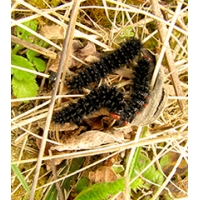
Glanville Fritillary Melitaea cinxia
Feed on Narrow-leaved Plantain. Easiest to keep on potted foodplant, enclosed in a sleeve. The larvae are gregarious, living in a tight bunch at the base of the plant, and spreading out more as they grow larger. The ginger head capsule and jet black body distinguish these larvae from other species.
In Britain this species lives mainly on the Isle of Wight coast, but they have been established elsewhere in Britain. Maybe they could be encouraged in more localities.
These larvae will produce butterflies this spring.
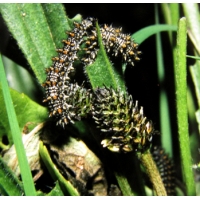
Heath Fritillary Melicta athalia
Allow the hatching larvae to feed and establish themselves in a pot of foodplant. Sleeve pot and all and leave out of doors for hibernation, exposed but in a place that drains.
Common in parts of Europe, and a rare and very localised species in Britain. The larvae thrive on narrow-leaved Plantain Plantago and bear a remarkable resemblance to its flowerheads. Larvae supplied in July/August will normally hibernate, but in warm conditions, some may grow and produce butterflies again this year.
Hibernation is best carried out with larvae on a substantial potted foodplant, pot and plant sleeved for protection. Keep outside in all weathers but away from flooding.
Heath Fritillary Melicta athalia
Common in parts of Europe, and a rare and very localised species in Britain. The larvae thrive on narrow-leaved Plantain Plantago and bear a remarkable resemblance to its flowerheads. Larvae supplied in July/August will normally hibernate, but in warm conditions, some may grow and produce butterflies again this year.
Hibernation is best carried out with larvae on a substantial potted foodplant, pot and plant sleeved for protection. Keep outside in all weathers but away from flooding.
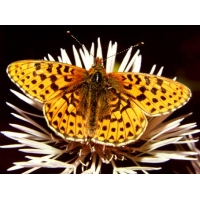
Pearl-bordered Fritillary Clossiana euphrosyne
Becoming rather a scarce species. Very difficult to obtain.
Larvae best kept on a pot of violet enclosed in a sleeve or escape-proof cage.
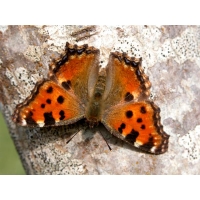
Large Tortoiseshell Nymphalis polychloros
Exceptionally difficult to obtain.
One of Europe’s grand butterflies! Now thought to be extinct in Britain. The larvae feed on a variety of fruit trees, Willow, Sallow, Elms, Aspen, Poplars and Birches. Easy to rear, particularly when sleeved on growing foodplant, but protect from excessive rain. Butterflies are produced this year. A very popular species. Please order early. Could you help establish this extinct British species in your area?
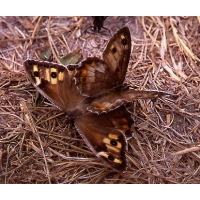
Grayling Butterfly Hipparchia semele

This heathland butterfly is a joy to watch, particularly when it rests and turns itself at an angle away from the sun to cast the minimum shadow. Such a clever ruse! Easily reared on potted coarse grasses. The pupa is formed in a loose cocoon amongst the roots of grasses, looking rather moth-like.

Marbled White Butterfly Melanargia galathea
A favourite from the chalk downlands of southern Britain. The female scatters her spherical eggs, unattached, amongst meadow grasses. The larvae hibernate on potted coarse grasses and produce butterflies next year. To hibernate these larvae you need potted grass, securely contained in a netting sleeve. Make sure you evict any spiders or other predatory creatures! Keep the pot outside in natural weather conditions.
In spring the larvae will stray and again in summer when they are ready to find a secluded place in which to hang and change to pupae, so make sure they are in a secure cage.

Duke of Burgundy Fritillary Hamearis lucina
It is years since we have had Duke of Burgundy larvae. Now very hard to obtain.
Curious oval larvae like those of the Blues, but not green like those, more a straw colour, with rows of black dots. They live on Primrose or Polyanthus leaves.
Not difficult to rear on a potted plant. Resulting pupae have similar colouring and pattern. Store the pupae in a fridge until May when the delightful butterflies emerge.
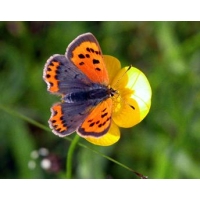
Small Copper Butterfly Lycaena phlaeas
The larvae feed on common Dock and Sorrel. If kept warm they may pupate and produce butterflies before winter. In nature the larvae hibernate deep in plant litter. To hibernate the larvae, keep on a potted foodplant, completely enclosing plant and pot in a sleeve, and keep out of doors in all weathers.
Small Copper Butterfly Lycaena phlaeas
The larvae feed on common Dock and Sorrel. If kept warm they may pupate and produce butterflies before winter. In nature the larvae hibernate deep in plant litter. To hibernate the larvae, keep on a potted foodplant, completely enclosing plant and pot in a sleeve, and keep out of doors in all weathers.