
SPRING and SUMMER EGGS and LARVAE Order now for supply in season

Bath White Pontia daplidice
Autumn Pupae may also become available.
The larvae feed on Mignonette, a flower of chalk soil, but they also feed on various Mustard family Cruciferae. Some people have done well rearing them on cauliflower - just let them loose on the raw heads!
This is a very rare migrant to Britain, found usually in the Mediterranean region. Baden Powel, a naturalist as well as pioneer, used the dappled pattern on the butterfy’s wings to disguise the plan of Mafeking when dispatched under siege!

EARLY Small Tortoiseshell Aglais urticae
One of the best species for young people and beginners. Larvae are sent in April/May. The best way to keep the young caterpillars is on potted nettles which should be prepared in early spring , regularly watered, and kept out of doors to make stocky growth. Prepare more than one pot of nettle. When the young larvae are received, bring the potted nettle indoors and place the young larvae on the foodplant, where they will look after themselves until they finish the food and are large enough to be kept in a cage on cut nettle in a jar of water. In a matter of weeks the pupae are formed hanging from the cage top, and the butterflies emerge in a little over a fortnight.
The butterflies can be kept in a cage for a few days, with plenty of flowers for nectar, and then released to help the wild populations.
Keeping two species of larvae together on the same foodplant? It is sometimes possible, but their way of life may differ and we recommend keeping them separately.
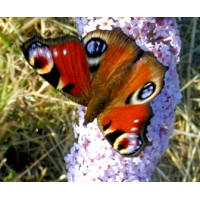
EARLY Peacock Butterfly (Inachis io)
Peacock and Small Tortoiseshell populations are seriously depleted recently, due to the butterflies waking in the mild winter and dying of starvation. This is a a chance to help local Peacock populations.
The larvae live in tight clusters on the tips of nettle. Young larvae do best on potted nettle. Keep the pots outside until needed indoors for the first larvae. When the larvae are larger, keep them caged on cut stems of nettle in a jar of water. Pupae are formed in a matter of weeks, hanging from the cage top. Butterflies emerge in about 3 weeks. They can be kept for a few days in a cage with flowers for nectar, then released into the wild.
Keeping two species of larvae together on the same foodplant? It is sometimes possible, but their way of life may differ and we recommend keeping them separately.
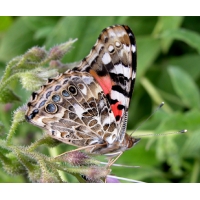
Painted Lady Vanessa cardui
Available only for delivery to GB addresses, not international orders.
Orders may be sent feeding on diet instead of leaf. This means they may travel better in the journey by post, and they can be changed to leaf on arrival.
The Painted Lady butterfly occurs in more continents of the world than any other butterfly. The larvae are easy to rear on Thistle (its preferred food plant), Burdock, Stinging Nettle, Mallow, Hollyhock and will often take other foodplants.
Each larva lives solitarily from birth. It spins a protective silk cover, living at first off the leaf cuticle. When possible, keep the larvae on a growing foodplant, which enables the caterpillar to make its silk cover, and move on to fresh food when it requires. If kept on cut food, please ensure that the plant is kept fresh and changed before the quality of the food suffers. This of course applies to all species, but the method has to take into account the solitary habit of the larva, and its protective silk. The best way is to enclose pot and foodplant in a sleeve. The WWB zipped sleeves make this a very convenient rearing method.
Depending on temperature, the larvae pupate in a little over a month. Butterflies emerge in 2-3 weeks. The cycle continues throughout summer and several broods are possible in a season.
The butterflies can be kept with nectar flowers for some days, and then except in the colder months October to March, released to breed in the wild.
There may be a delay of a couple of weeks if larvae are not at the right size for sending. Can be ordered immediately.
Larvae are often quite small when sent. Too small to be put into a cage or aquarium. They are best reared on growing foodplant, enclosed in a sleeve. Alternatively keep in a plastic box, lined with absorbent paper, and changed daily. For details see the All Colour Paperback BUTTERFLIES.

Five Painted Lady larvae in Total Environment Pot
Available only for delivery to GB addresses, not international orders.
The five Painted Lady caterpillars live their whole life inside the see-through pot which contains all they need from birth to pupating. You need add no food. You don’t even clean them out and they look after themselves over weekends!
The larvae grow quite quickly in summer indoor conditions (never keep them in direct sunshine). The container is easily passed round a group without disturbance to the larvae.
During skin change the larvae do not move or eat This may last a day or two.
Don't be alarmed by this: it is a natural stage in their development.
When the larvae have finished eating, they suspend themselves from a silk pad spun on special absorbent paper in the lid. Here they cast their caterpillar skin. If you are lucky and look at the right moment you can see the actual moment of change from caterpillar to chrysalis.
Let the chrysalis harden for a couple of days, then hang the paper pinned inside a cage for the butterflies to emerge.
You can keep the butterflies for a few days in a cage with nectar flowers. Then, except in the colder months October to March, release them into the wild where they may breed naturally in your area. Please keep the larvae and pupae in an even room temperature (around 18-22º) day and night. Keep away from direct sunlight or a direct heat source such as a radiator.
The instructions are printed above - please note them for the arrival of the larvae which are not sent with further instructions. If you are sending larvae as a present, please remember the recipient will not have these instructions, unless you copy them to the recipient.
Can be ordered in advance. During the season there may be a delay of a couple of weeks or more if larvae are not currently at the size for sending.

Comma Butterfly Polygonia c-album
Fascinating larvae with curious half and half markings in black, brown and white, mimicking a bird dropping. The larvae feed on Stinging Nettle, Elm and Hop. Also Sallow, Osier Willow Salix viminalis, and sometimes other Willows. They live singly. Fast growing.
Young larvae will succeed best if placed on growing foodplant. Enclose plant and pot in a netting sleeve, tied at both ends: size 3 is ideal. Otherwise you can sleeve Comma larvae on branches of Elm, Sallow and Willows, including Osier. Good ventilation is required. Cut food is not recommended at least until the larvae are nearly half grown. Comma larvae do not like crowding, and do best kept so that each caterpillar can get away and live on its own. Disease can occur if conditions are not perfect. If it does, it helps that the larvae live separately. Any infected or dead larvae should be removed and disinfection should be carried out, lightly spraying 10% bleach solution, which will not affect healthy larvae, but does help prevent the spread of disease.
This garden butterfly is capable of re-colonising places where it used to be. In autumn the butterflies are very partial to fallen fruit. With some help this butterfly could be encouraged to spread.
Keeping two species of larvae together on the same foodplant? It is sometimes possible, but their way of life may differ and we recommend keeping them separately. Comma larvae live solitary lives and should be reared in their own enclosure.
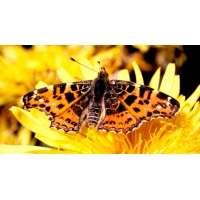
Map Butterfly Araschnia levana
Very rarely have we have been able to list this species as larvae. A charming and quite small Vanessid butterfly that occurs throughout much of Europe but not in the British Isles. It has been established in Britain but the colony was deliberately destroyed. This is a nettle feeder. The eggs are laid in unique pendant strings from the underside of a nettle leaf. Younger larvae are gregarious. There are normally two broods: the spring brood is patterned rather like a fritillary, as illustrated. In July the second brood (form porosa) emerges looking like miniature White Admirals! Pairing is not easy but success is more likely if you can create a netting sleeve that brings the two sexes together, like the peak of a hood. Second brood larvae hang up to pupate in secluded places for the winter.
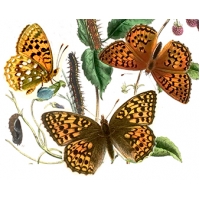
Dark Green Fritillary Mesoacidalia aglaia
Best reared on potted Violet. These larvae are in hibernation. Keep the larvae in winter out of doors, in all weathers, protected amongst dead bramble and other leaves, amongst growing Violet. Cover with netting sleeve to exclude predators and to prevent escape.

Marsh Fritillary Eurodryas aurinia
SPECIAL PRICE FOR 20 Larvae!
Larvae feed low amongst the leaves of Devil’s Bit Scabioius, but will also eat Honeysuckle. Honeysuckle starts leafing very early in the year, especially where sheltered in woodland. By February it is not diffficult to find enough foodplant to keep caterpillars well fed. In captivity the larvae are recorded as accepting Ribwort Plantain Plantago lanceolata, Teasel Dipsacus and Snowberry Symphoricarpos.
Pre-hibernation larvae might be induced to develop and produce another generation with long day-length and sufficient warmth.
After waking in the spring the larvae grow fast, pupating in April and emerging as butterflies in May.
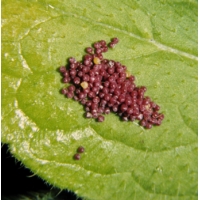
Marsh Fritillary Eurodryas aurinia
It's a very long time since we have been able to offer egg masses. Each mass should produce 100-200 larvae. Amazing value!
They feed low amongst the leaves of Devil’s Bit Scabioius, but will also eat Honeysuckle. Honeysuckle starts leafing very early in the year, especially where sheltered in woodland. By February it is not diffficult to find enough foodplant to keep caterpillars well fed. In captivity the larvae are recorded as accepting Ribwort Plantain Plantago lanceolata, Teasel Dipsacus and Snowberry Symphoricarpos.
Cage or sleeve the larvae on growing foodplant, kept out of doors in a spot sheltered from extreme wind, but open to all weather, including frost, rain and snow. This is what winter throws at them in the wild, and they are adapted to it.
After waking in the spring the larvae grow fast, pupating in April and emerging as butterflies in May.

Marsh Fritillary Eurodryas aurinia
Larvae feed low amongst the leaves of Devil’s Bit Scabioius, but will also eat Honeysuckle. Honeysuckle starts leafing very early in the year, especially where sheltered in woodland. By February it is not diffficult to find enough foodplant to keep caterpillars well fed. In captivity the larvae are recorded as accepting Ribwort Plantain Plantago lanceolata, Teasel Dipsacus and Snowberry Symphoricarpos.
Pre-hibernation larvae might be induced to develop and produce another generation with long day-length and sufficient warmth.
After waking in the spring the larvae grow fast, pupating in April and emerging as butterflies in May.

Marsh Fritillary SCOTTISH Eurodryas aurinia
Very scarce Scottish form. LIMITED NUMBERS!
Larvae feed low amongst the leaves of Devil’s Bit Scabioius, but will also eat Honeysuckle. Honeysuckle starts leafing very early in the year, especially where sheltered in woodland. By February it is not diffficult to find enough foodplant to keep caterpillars well fed. In captivity the larvae are recorded as accepting Ribwort Plantain Plantago lanceolata, Teasel Dipsacus and Snowberry Symphoricarpos.
Pre-hibernation larvae might be induced to develop and produce another generation with long day-length and sufficient warmth.
After waking in the spring the larvae grow fast, pupating in April and emerging as butterflies in May.